
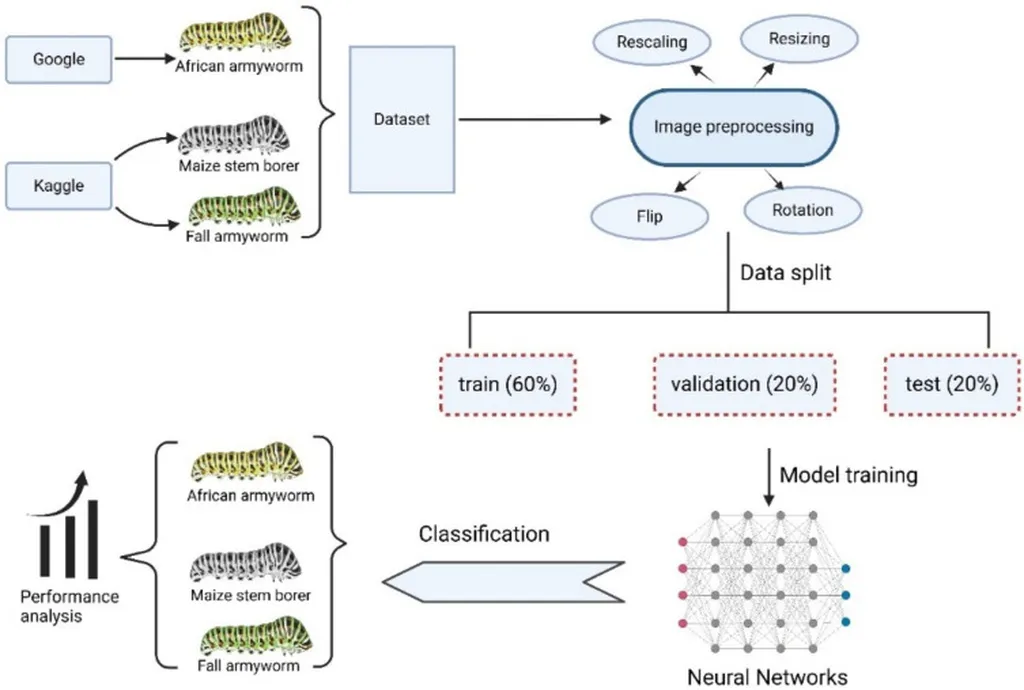
In the relentless battle against agricultural pests, precision is key. A recent study published in the journal *Agronomy* introduces a groundbreaking neural network model that could revolutionize the way farmers identify and manage infestations of the fall armyworm (*Spodoptera frugiperda*), a globally significant crop pest. The research, led by Quanyuan Xu from the College of Big Data and Intelligent Engineering at Southwest Forestry University in China, presents a novel approach to fine-grained instar identification, a critical factor in implementing targeted pest control measures.
The fall armyworm is a notorious agricultural menace, capable of devastating crop yields and causing significant economic losses. Traditional methods of identifying larval instar stages—essential for timely and effective intervention—are often labor-intensive and reliant on expert knowledge. Deep learning models have shown promise, but they frequently struggle with the subtle morphological differences between instars, leading to inaccuracies and inefficiencies.
Enter MSA-ResNet, or Multi-Scale Improved Self-Attention ResNet. This innovative model integrates large convolutional kernels, atrous spatial pyramid pooling, and an improved self-attention mechanism into the ResNet50 backbone. These enhancements enable the model to capture and discriminate the minute details that distinguish one instar stage from another with remarkable accuracy.
“Our model achieves an impressive 96.81% accuracy on the test set, significantly outperforming mainstream models like ResNet50, VGG16, and MobileNetV3,” Xu explained. “The improvements are particularly notable in the early instar stages, where precision and recall rates have seen substantial gains. This level of accuracy is a game-changer for precision agriculture and sustainable pest management.”
The implications for the agriculture sector are profound. Accurate instar identification allows for the precise application of pesticides, reducing overall usage and minimizing environmental impact. It also enables farmers to implement targeted control measures at the optimal time, thereby protecting crop yields and enhancing food security.
“By integrating advanced neural networks into agricultural practices, we can achieve a more sustainable and efficient approach to pest management,” Xu added. “This technology has the potential to transform the way we combat agricultural pests, making it a valuable tool for farmers worldwide.”
The study’s findings are not just a testament to the power of deep learning but also a beacon of hope for the future of smart agriculture. As the agricultural sector continues to embrace technological advancements, the integration of AI-driven solutions like MSA-ResNet could pave the way for more resilient and productive farming practices.
The research, published in *Agronomy* and led by Quanyuan Xu from the College of Big Data and Intelligent Engineering at Southwest Forestry University, offers a transferable reference for fine-grained image recognition tasks in agricultural pest management, setting a new standard for precision and efficiency in the field.