
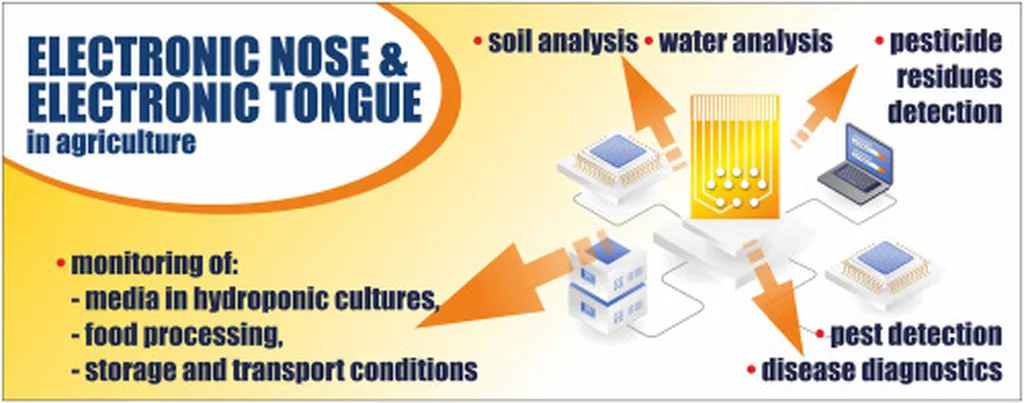
In the rapidly evolving landscape of precision agriculture, researchers are continually seeking innovative methods to enhance soil nutrient detection, a critical component for optimizing crop yields and sustainability. A recent study published in *Agronomy* introduces a groundbreaking approach that combines pyrolysis, electronic nose technology, and advanced machine learning to achieve rapid and accurate soil nutrient analysis. This method could revolutionize how farmers and agronomists assess soil health, potentially leading to significant commercial impacts across the agriculture sector.
The research, led by Li Lin from the College of Engineering and Technology at Jilin Agricultural University in China, focuses on developing a detection method that leverages the unique capabilities of an electronic nose system. This system, equipped with 10 metal oxide semiconductor gas sensors, collects response signals from soil samples subjected to pyrolysis at 400 °C. The study’s innovative approach involves extracting time-domain and frequency-domain features from these sensor responses, initially constructing a dataset of 180 features. To refine this dataset, the researchers proposed a novel feature fusion method that combines Pearson correlation coefficients (PCC) with recursive feature elimination cross-validation (RFECV). This method enhances the representational power of the data and selects key sensitive features, improving the accuracy of nutrient predictions.
One of the study’s most compelling aspects is its comparison of different machine learning models for predicting soil organic matter (SOM), total nitrogen (TN), available potassium (AK), and available phosphorus (AP) content. The researchers evaluated support vector machines (SVM), support vector machine-random forest models (SVM-RF), and particle swarm optimization-enhanced support vector machine-random forest models (PSO-SVM-RF). The results were impressive, with the PSO-SVM-RF model demonstrating optimal performance across all nutrient predictions. For SOM and TN, the model achieved a coefficient of determination (R²) of 0.94, with a performance-to-bias ratio (RPD) exceeding 3.8. For AK and AP, the R² values improved to 0.78 and 0.74, respectively, with significant reductions in root mean square error (RMSE) compared to the SVM model.
“The combination of electronic nose technology with advanced machine learning models offers a promising solution for rapid and accurate soil nutrient analysis,” said Li Lin, the lead author of the study. “This approach not only enhances the precision of soil fertility assessments but also has the potential to streamline agricultural practices, leading to more sustainable and productive farming.”
The commercial implications of this research are substantial. Precision agriculture relies heavily on accurate and timely soil nutrient data to optimize fertilizer use, improve crop yields, and minimize environmental impact. The proposed method could significantly reduce the time and cost associated with traditional soil testing methods, making it an attractive option for farmers and agronomists worldwide. Additionally, the study’s findings could pave the way for further advancements in soil sensing technologies, potentially leading to the development of portable and user-friendly devices for on-site soil analysis.
As the agriculture sector continues to embrace digital transformation, the integration of electronic nose technology with machine learning models represents a significant step forward. This research not only validates the feasibility of such an approach but also highlights its potential to shape the future of soil fertility assessment. By providing a more efficient and accurate means of detecting soil nutrients, this method could contribute to the broader goals of sustainable agriculture and food security.
The study, published in *Agronomy*, was led by Li Lin from the College of Engineering and Technology at Jilin Agricultural University in China. The findings offer a glimpse into the future of precision agriculture, where technology and innovation converge to address the pressing challenges faced by the global agriculture sector. As researchers continue to explore the capabilities of electronic nose technology and machine learning, the potential for further advancements in soil nutrient detection remains vast, promising a more sustainable and productive future for agriculture.