
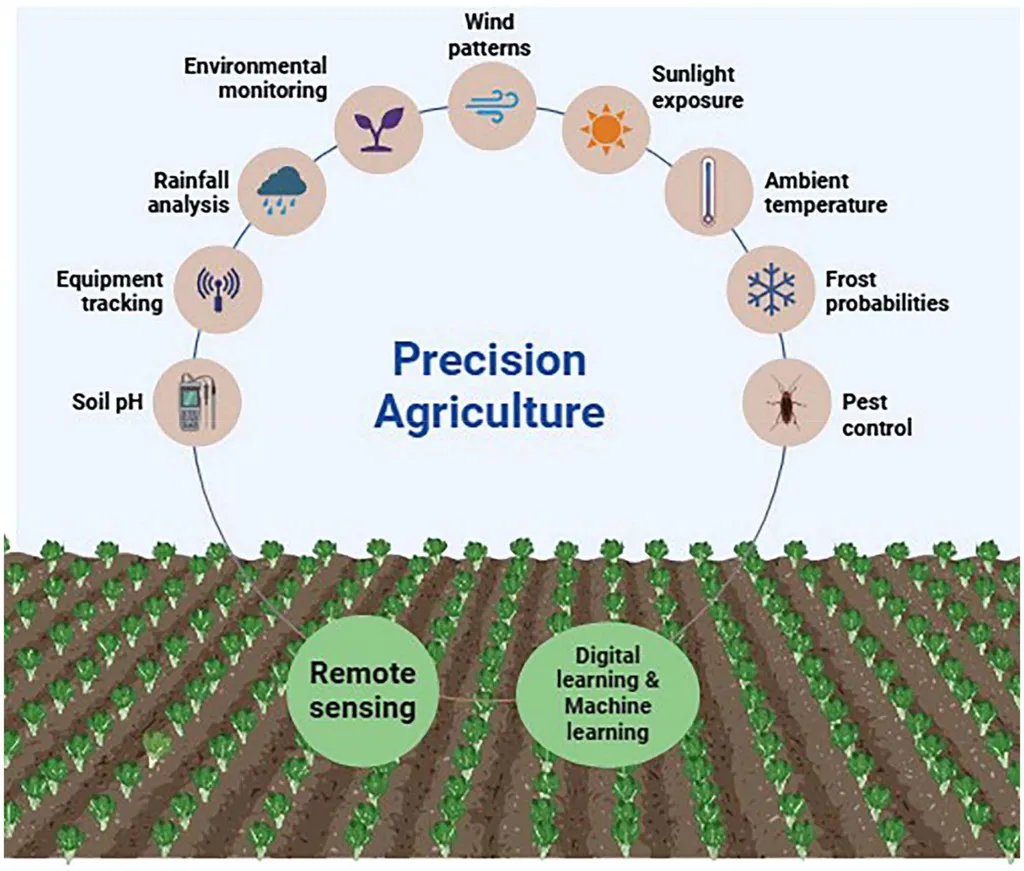
In the ever-evolving landscape of precision agriculture, researchers are continually seeking innovative methods to enhance crop yield and nutritional content. A recent study published in the *Plant Phenome Journal* offers a promising approach to predicting yield and protein content in dry peas (*Pisum sativum* L.) using a combination of multispectral data and advanced machine learning models. This research, led by Aliasghar Bazrafkan from the Department of Agricultural and Biosystems Engineering at North Dakota State University, could significantly impact the agriculture sector by providing more accurate, non-destructive, and scalable solutions for crop management.
Traditional methods for estimating yield and protein content in dry peas are often labor-intensive and limited in scope. The study addresses these challenges by integrating data collected from uncrewed aerial system-mounted multispectral sensors across 860 genotypes over three growing seasons in North Dakota. The researchers employed stacked meta-models, a type of ensemble learning, to analyze the data and enhance prediction accuracy.
The results were promising. The meta-model outperformed individual machine learning models, achieving a root mean squared error (RMSE) of 396.28 kg ha−1 and a coefficient of determination (R2) of 0.77 for yield prediction. “The meta-model demonstrated strong predictive performance for yield, which is a significant step forward in our quest for more accurate and efficient agricultural predictions,” said Bazrafkan.
However, the prediction of protein content was less accurate, with an RMSE of 1.28% and an R2 of 0.54. This discrepancy highlights the limitations in the correlation between spectral features and protein synthesis. “While the results for protein content were moderate, they provide a starting point for further research and refinement,” Bazrafkan noted.
The study also emphasized the critical importance of growth stages, particularly the maturity stages, in predicting yield and protein content. This insight could guide future research and practical applications, ensuring that predictions are tailored to specific growth stages for optimal accuracy.
The commercial implications of this research are substantial. By providing more accurate and scalable methods for predicting yield and protein content, farmers and agribusinesses can make more informed decisions about crop management, resource allocation, and market strategies. This can lead to improved productivity, sustainability, and nutritional outcomes, ultimately benefiting both the agriculture sector and consumers.
Looking ahead, the researchers suggest that future studies should focus on incorporating additional data sources, refining feature engineering techniques, and tailoring models to specific growth stages. These advancements could further improve predictive accuracy and broaden the applicability of the models to other pulse crops.
In conclusion, this study represents a significant step forward in the integration of multispectral data and machine learning for agricultural predictions. As Bazrafkan and his team continue to refine their models and explore new avenues of research, the potential for enhancing precision agriculture practices in pulse crops becomes increasingly promising. The findings published in the *Plant Phenome Journal* offer a foundation for advancing the field and shaping the future of sustainable and productive agriculture.