
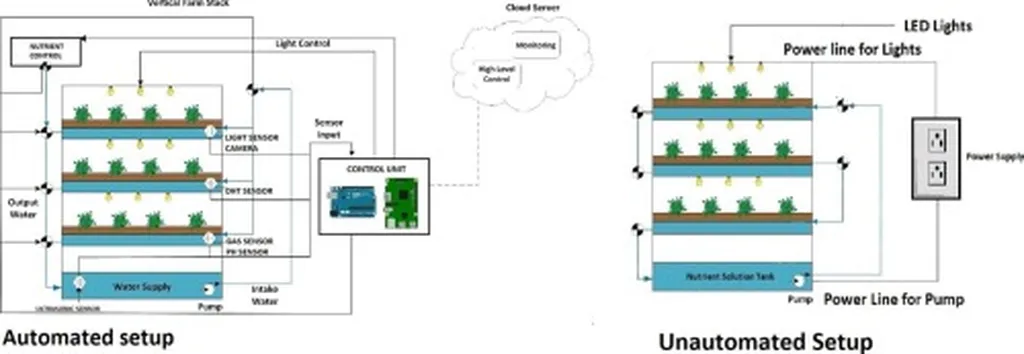
In the rapidly evolving world of agriculture, technology is playing an increasingly pivotal role in enhancing efficiency and sustainability. A recent study published in *Jurnal ELTIKOM: Jurnal Teknik Elektro, Teknologi Informasi dan Komputer* introduces a groundbreaking system that could revolutionize hydroponic farming. Led by Muhammad Alimussadad from Universitas Negeri Malang, Indonesia, the research presents a smart hydroponic nutrient monitoring and control system that leverages fuzzy logic and IoT technology to dynamically adjust nutrient levels based on real-time data and plant growth stages.
Hydroponic farming, a method of growing plants without soil, offers numerous advantages, including water efficiency and faster growth rates. However, maintaining optimal nutrient levels has been a persistent challenge. Traditional systems often struggle with overshoot and fail to adapt to external changes or disturbances. Alimussadad’s system addresses these issues by integrating a Sugeno-type fuzzy logic controller with an IoT-based application, enabling real-time monitoring and precise control of nutrient and water levels.
“The system dynamically adjusts nutrient and water levels based on real-time sensor data and the plant’s growth phase,” Alimussadad explained. “This adaptability ensures that the plants receive the exact nutrients they need at each stage of their growth, leading to improved productivity and health.”
The system utilizes nutrient, water level, and temperature sensors connected to an ESP32 microcontroller. The fuzzy logic controller determines the duration for which solenoid valves should be activated, ensuring precise nutrient delivery. The results were impressive: the control system achieved stable regulation with zero overshoot and a settling time of 840 seconds. It also effectively recovered from nutrient disturbances, demonstrating its robustness in varying conditions.
Growth tests on celery plants showed remarkable improvements. Compared to manual control, the system achieved a 102.6% increase in plant height, a 275% increase in stem diameter, and a 112.5% increase in leaf width. These results highlight the system’s potential to significantly enhance plant productivity and quality.
The integration of IoT technology allows farmers to monitor hydroponic parameters in real-time through a mobile application. This feature not only improves convenience but also enables proactive management, reducing the risk of nutrient deficiencies or excesses that could harm plant health.
The commercial implications of this research are substantial. As the demand for sustainable and efficient agricultural practices grows, technologies like this smart nutrient monitoring and control system could become indispensable tools for farmers. By optimizing nutrient delivery and improving plant growth, the system can lead to higher yields, reduced resource waste, and increased profitability.
“This technology has the potential to transform hydroponic farming by making it more precise, efficient, and scalable,” Alimussadad noted. “It can help farmers achieve consistent and high-quality yields, ultimately contributing to food security and sustainability.”
The research published in *Jurnal ELTIKOM* by Muhammad Alimussadad and his team from Universitas Negeri Malang, Indonesia, represents a significant advancement in the field of agritech. As the agriculture sector continues to embrace technological innovations, systems like this could pave the way for a more sustainable and productive future. The integration of fuzzy logic and IoT in hydroponic farming not only addresses current challenges but also opens up new possibilities for future developments in precision agriculture.