
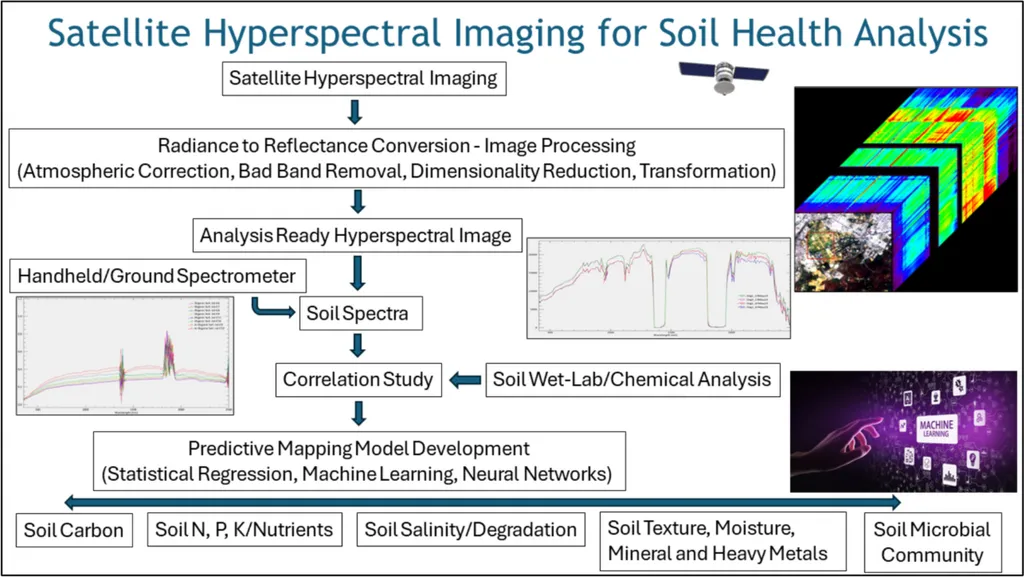
In the heart of Tamil Nadu, India, a groundbreaking study is transforming how we understand and manage soil health. Researchers have successfully harnessed the power of hyperspectral imaging and machine learning to estimate soil nutrient content with remarkable accuracy. This innovative approach, detailed in a recent paper published in *AgriEngineering*, promises to revolutionize precision agriculture by making soil analysis faster, more efficient, and less invasive.
Traditional soil sampling methods are labor-intensive and time-consuming, often requiring destructive sampling that can disrupt the very ecosystems farmers are trying to sustain. Enter hyperspectral imaging, a technology that captures detailed spectral information across a wide range of wavelengths. When combined with advanced machine learning techniques, it offers a non-invasive, rapid, and remote assessment of soil health.
The study, led by Anand Raju from the Department of Electrical and Electronics Engineering at Amrita Vishwa Vidyapeetham in Coimbatore, employed the red fox optimization (FOX) algorithm for spectral band selection. This algorithm effectively reduces data redundancy while retaining the most informative features, enhancing the accuracy of soil nutrient predictions.
“Our goal was to develop a robust and computationally efficient method for soil nutrient estimation,” Raju explained. “The FOX algorithm proved to be highly effective in optimizing the spectral bands, which significantly improved the performance of our machine learning models.”
The results were impressive. The partial least squares regression (PLSR) model achieved an R² value of 0.93 for organic carbon, with a mean absolute error (MAE) of 16.4 and a root mean square error (RMSE) of 20.1. For nitrogen, phosphorus, and potassium, the R² values all exceeded 0.89, demonstrating the robustness of the FOX-optimized models.
The implications for the agriculture sector are profound. Accurate, real-time soil nutrient estimation can enable farmers to make data-driven decisions, optimizing fertilizer use and improving crop yields. This not only enhances productivity but also promotes sustainable soil management practices, reducing the environmental impact of agriculture.
“The integration of hyperspectral imaging with optimized machine learning techniques opens up new possibilities for precision agriculture,” Raju noted. “It allows for large-scale, non-destructive soil monitoring, which is crucial for sustainable farming practices.”
As the agriculture industry continues to evolve, the adoption of such technologies is expected to grow. The study’s findings pave the way for future developments in soil health monitoring, potentially leading to more efficient and environmentally friendly farming practices. With the increasing demand for sustainable agriculture, this research offers a timely and impactful solution.
In a rapidly changing agricultural landscape, the fusion of hyperspectral imaging and machine learning stands as a beacon of innovation, promising to shape the future of soil management and precision agriculture.