
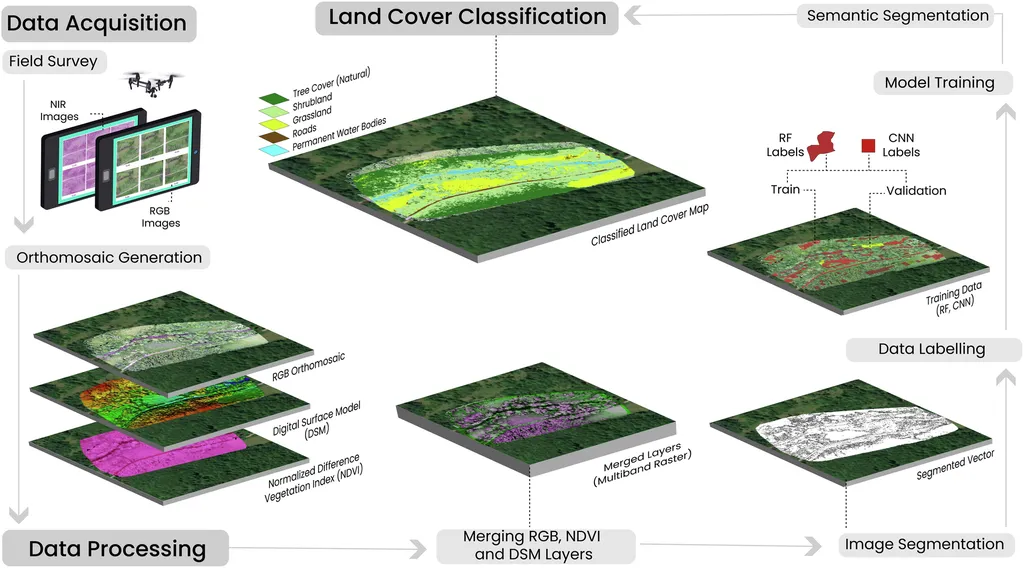
In the rapidly evolving world of precision agriculture and forest management, Unmanned Aerial Vehicles (UAVs) are emerging as game-changers. A comprehensive review published in *AgriEngineering* sheds light on the transformative potential of UAV-derived vegetation indices (VIs), offering a glimpse into the future of sustainable land management.
The study, led by Adrian Peticilă from the Department of Bioengineering of Horti-Viticultural Systems at the University of Agronomic Sciences and Veterinary Medicine of Bucharest, synthesizes global advances from 2015 to 2024. By analyzing 472 peer-reviewed publications, the research identifies key trends, dominant indices, and technical progress achieved through various sensors, including RGB, multispectral, hyperspectral, and thermal.
“UAVs provide rapid, high-resolution data collection over wide areas, making them indispensable for precision agriculture and forest monitoring,” Peticilă explains. The review highlights an exponential growth in scientific output, with China, the USA, and Europe leading the charge. Traditional indices like NDVI (Normalized Difference Vegetation Index), NDRE (Normalized Difference Red Edge), and GNDVI (Green Normalized Difference Vegetation Index) remain widely applied, but new indices such as GSI (Green-Seekers Index), RBI (Red-Blue Index), and MVI (Moisture Stress Index) are gaining traction for their enhanced sensitivity to stress and disease detection in both crops and forests.
The practical applications of UAV-based monitoring are vast. From yield prediction and water-stress evaluation to pest identification and biomass estimation, the technology is proving its worth in the field. “The integration of UAV-derived vegetation indices with machine learning and multi-sensor data represents a transformative approach for the sustainable management of agricultural and forest ecosystems,” Peticilă notes.
However, challenges remain. Illumination correction, soil background influence, and limited forestry applications are areas that require further research. Despite these hurdles, the potential commercial impacts for the agriculture sector are significant. Farmers and forest managers can leverage UAV technology to optimize resource use, increase productivity, and reduce environmental impact.
As the technology continues to evolve, the integration of UAV-derived vegetation indices with advanced analytics and artificial intelligence could revolutionize the way we manage our land. The research published in *AgriEngineering* by lead author Adrian Peticilă from the University of Agronomic Sciences and Veterinary Medicine of Bucharest offers a roadmap for future developments, highlighting the critical role of UAVs in shaping the future of precision agriculture and forest management.