
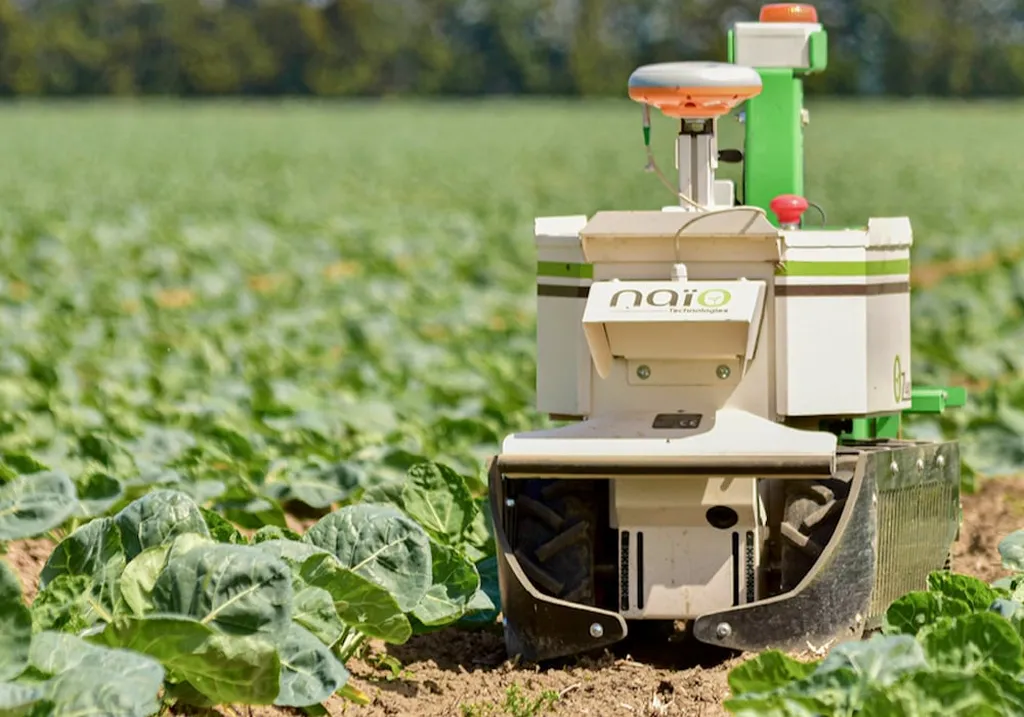
In the ever-evolving landscape of precision agriculture, a groundbreaking study published in *Agronomy* has introduced a vision-guided, electrically actuated inter-row cultivator that promises to revolutionize weed management in maize fields. Developed by Haonan Yang and colleagues at the Intelligent Equipment Research Center, Beijing Academy of Agriculture and Forestry Sciences, this innovative technology could significantly reduce herbicide use while enhancing the soil-crop environment.
The cultivator, crafted from Q235 low-carbon structural steel, employs advanced computer vision to recognize maize plants and compute real-time lateral deviations between the implement and crop rows. This data drives a servo-electric cylinder, enabling precise ±15 cm inter-row adjustments. “The system’s ability to make real-time adjustments ensures that the cultivator stays aligned with the crop rows, minimizing the risk of damaging the maize plants while effectively uprooting weeds,” explains Yang.
Field tests conducted at a forward speed of 0.51 m/s revealed impressive accuracy. With an initial offset of 5 cm, the mean absolute error ranged from 0.76 to 1.03 cm, and at 15 cm, the 95th percentile error was 7.5 cm. The study also established a root damage quantification method, highlighting that the optimal operating window for the cultivator is during the V4 to V5 growth stage of maize, where root damage rates are manageable.
The commercial implications of this research are substantial. By eliminating the need for herbicide application, the system addresses critical issues related to residues, drift, and resistance management. “This technology not only reduces the environmental impact but also lowers the operational costs for farmers,” says Yang. Compared to laser weeding, which requires high power density and has limited effective width, the tractor-implement system enables full-width weeding and shallow inter-row tillage in a single pass, seamlessly integrating with existing mechanized operations.
The study’s findings, while promising, are based on a single forward speed and field configuration. Further validation under higher speeds and broader field conditions is necessary to fully realize the system’s potential. However, the results obtained so far support the notion that precision agriculture is poised to take a significant leap forward with this vision-guided inter-row cultivator.
As the agriculture sector continues to embrace technological advancements, this research by Yang and his team could pave the way for more sustainable and efficient farming practices. The integration of computer vision and electric actuation in agricultural machinery represents a paradigm shift, offering a glimpse into the future of precision agriculture. With continued development and validation, this technology could become a cornerstone of modern farming, benefiting both the environment and the agricultural industry.