
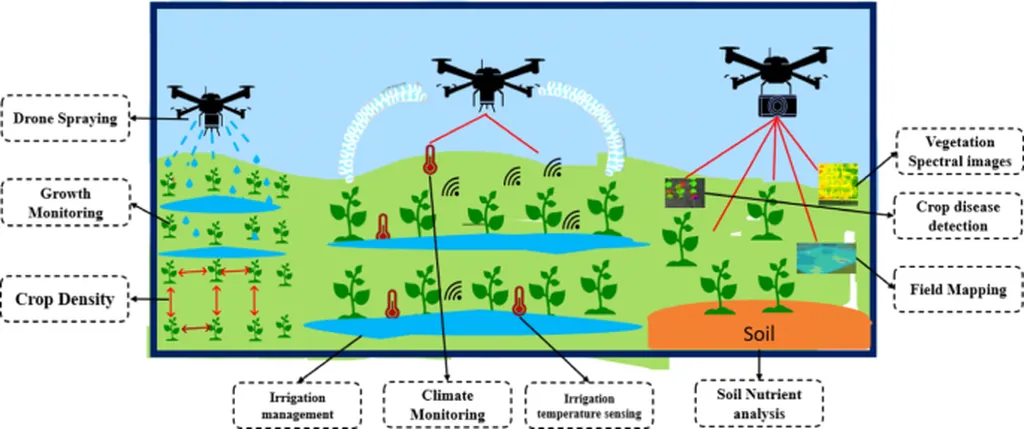
In the ever-evolving landscape of precision agriculture, a groundbreaking study published in *IEEE Access* is set to redefine how uncrewed aerial vehicles (UAVs) navigate the complex three-dimensional environments of greenhouses. The research, led by Shikang Wu from the College of Information Science and Engineering at Shanxi Agricultural University, introduces a novel framework that combines Digital Twin (DT) technology with a hybrid optimization algorithm to enhance UAV path planning in greenhouse agriculture.
Traditional two-dimensional (2D) path planning algorithms have long been insufficient for the dynamic and intricate environments of greenhouses. The new DT-driven framework integrates the Dung Beetle Optimizer (DBO) and Genetic Algorithm (GA) with Agent-Based Modeling (ABM) to create a robust system capable of real-time adaptation and efficient coverage. This innovative approach promises to revolutionize the way UAVs are deployed in agricultural settings, offering significant commercial benefits for the sector.
The core of the framework lies in its ability to collect real-time data from the physical greenhouse via IoT sensors and LiDAR, synchronizing updates to a virtual replica. This Digital Twin module provides the necessary environmental parameters, such as temperature, humidity, and wind speed, to generate dynamic 3D pest heatmaps. The Dung Beetle Optimizer then leverages these heatmaps to guide global exploration of high-pest-density hotspots, generating candidate paths. Subsequently, the Genetic Algorithm refines these paths to avoid obstacles and improve kinematic adaptability for UAVs.
“Our framework not only enhances the efficiency of UAV operations but also ensures adaptive path correction in real-time,” said Shikang Wu. “This closed-loop system allows for continuous optimization, making it highly suitable for the complex and dynamic environments of greenhouses.”
The practical implications of this research are substantial. By achieving a 96.8% coverage rate, shortening path length by 32%, and reducing computation time by 28%, the proposed framework demonstrates a strong balance between global search and local optimization. This efficiency translates to cost savings and improved productivity for farmers, as UAVs can more effectively monitor and manage pest infestations, crop health, and environmental conditions.
The integration of DT, ABM, DBO, and GA creates a synergistic effect that enhances the overall performance of UAVs in agricultural settings. The DT module ensures real-time feedback, allowing for adaptive path correction based on sudden environmental changes. The ABM generates dynamic 3D pest heatmaps, focusing on whitefly diffusion, which guides the UAVs to high-pest-density areas. The DBO and GA work together to optimize the paths, ensuring efficient coverage and obstacle avoidance.
“This research opens up new possibilities for precision agriculture,” said Wu. “By leveraging advanced technologies like Digital Twin and hybrid optimization algorithms, we can create more intelligent and adaptive systems that significantly improve the efficiency and effectiveness of agricultural operations.”
The commercial impact of this research is far-reaching. Farmers can expect to see reduced operational costs, increased crop yields, and improved pest management strategies. The framework’s ability to adapt to real-time environmental changes ensures that UAVs can operate more efficiently, reducing the need for manual interventions and minimizing the risk of crop damage.
As the agriculture sector continues to embrace technological advancements, the DT-ABM-DBO-GA framework offers a promising solution for enhancing UAV operations in greenhouse environments. The research, published in *IEEE Access* and led by Shikang Wu from the College of Information Science and Engineering at Shanxi Agricultural University, sets a new standard for precision agriculture, paving the way for future developments in the field.
The study’s findings highlight the potential for further innovation in agricultural technology. As researchers continue to explore the capabilities of Digital Twin technology and hybrid optimization algorithms, the agriculture sector can look forward to even more sophisticated and efficient solutions for managing greenhouse operations. This research not only addresses the immediate needs of farmers but also lays the groundwork for future advancements in precision agriculture.