
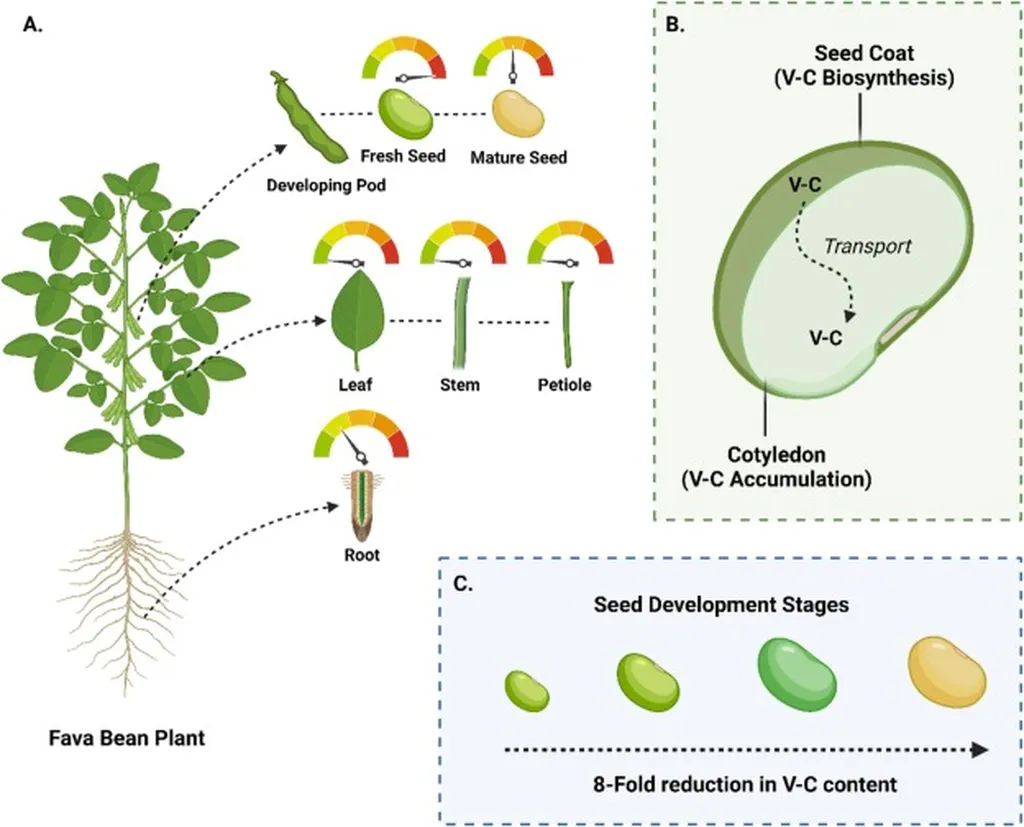
In a significant stride towards enhancing faba bean cultivation, researchers have unraveled the molecular mechanisms behind the maternal control of vicine and convicine (v-c) biosynthesis in seeds. This discovery, published in *Legume Science*, opens new avenues for breeding low v-c varieties, potentially boosting the crop’s commercial viability and nutritional value.
Faba beans, a vital legume in sustainable agriculture, are often overlooked due to the presence of v-c, compounds known to cause favism, a genetic disorder that affects red blood cells. Despite the identification of key genes involved in v-c biosynthesis, the process’s intricacies have remained elusive until now.
The study, led by Samson Ugwuanyi from the Department of Plant Breeding at Justus Liebig University Giessen, Germany, employed multiple reciprocal crosses between high and low v-c parental lines. The results were unequivocal: the seed v-c content is determined by the maternal genotype. “The F1 seeds consistently reflected the maternal v-c phenotype, indicating a strong maternal influence,” Ugwuanyi explained.
The research team delved deeper, analyzing the expression of VICINE-CONVICINE 1 (VC1) and RIBOFLAVIN BIOSYNTHESIS PROTEIN 2 (RIBA2) genes. They found that these genes are predominantly expressed in the seed coat, with the embryo remaining transcriptionally inactive during seed development. This tissue-specific expression suggests that maternal determination is regulated by developmental stage-specific transcription.
The findings also revealed that despite maternal control of v-c expression, the segregation of the v-c trait follows Mendelian ratios regardless of cross direction. This is a crucial insight for breeders, as it means that maternal phenotype does not affect breeding outcomes.
The commercial implications of this research are substantial. Faba beans are a valuable crop, not only for their high protein content but also for their role in sustainable agriculture. However, the presence of v-c has limited their broader utilization. With a better understanding of v-c biosynthesis and maternal inheritance, breeders can now develop low v-c varieties more efficiently.
“This research provides a molecular basis for maternal inheritance of v-c content,” Ugwuanyi said. “It offers practical insights for breeding strategies, including seed-based genotyping, marker-assisted selection, and hybrid or synthetic breeding.”
The study’s findings could significantly impact the agriculture sector, particularly in regions where faba beans are a staple crop. By reducing the v-c content, breeders can enhance the nutritional value of faba beans, making them a more attractive option for consumers and a more valuable commodity for farmers.
Moreover, the insights gained from this research could extend beyond faba beans. The principles of maternal inheritance and tissue-specific gene expression are universal, and understanding these mechanisms in one crop can provide valuable insights for others.
As the world grapples with the challenges of climate change and food security, crops like faba beans will play an increasingly important role. By enhancing their nutritional value and commercial viability, we can take a significant step towards a more sustainable and secure food future.