
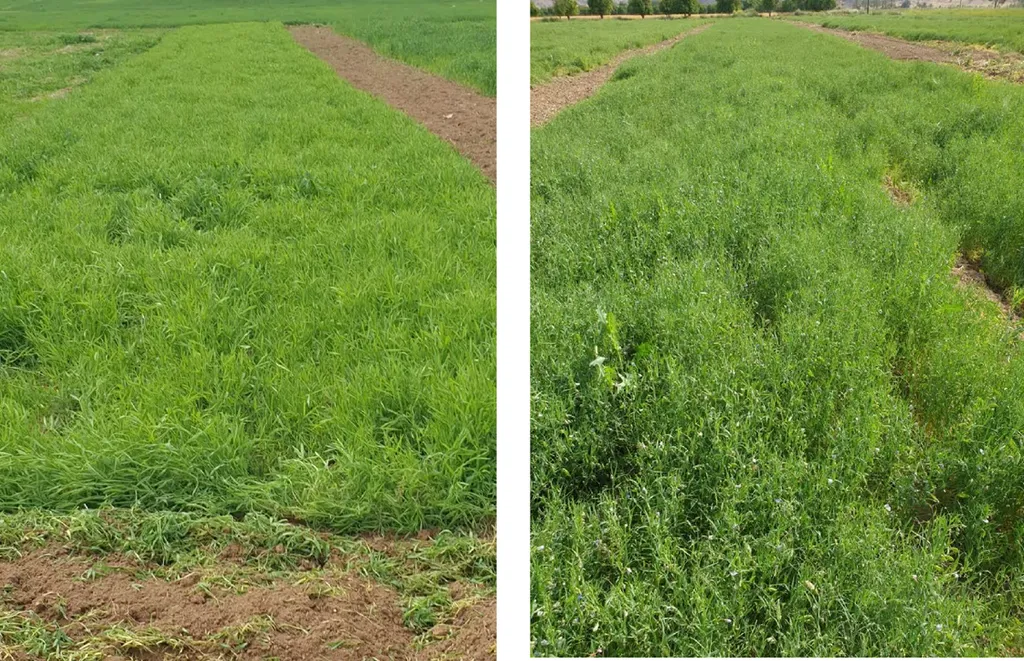
In the heart of Iran’s arid and semi-arid regions, a groundbreaking study is reshaping the future of rainfed agriculture, offering hope for farmers battling erratic weather patterns and climate change. The research, published in *Cogent Food & Agriculture*, delves into the stability of grass pea genotypes, a hardy crop that could hold the key to food security in marginal environments.
Led by Behrouz Vaezi of the Gachsaran Agricultural Research Campus and the National Rainfed Site, the study evaluated 16 grass pea genotypes across 12 diverse rainfed environments over three years. The findings underscore the complexity of selecting stable, high-yielding genotypes in the face of significant genotype-by-environment (G×E) interactions.
“Our study highlights the challenges farmers face when choosing the right crop varieties,” Vaezi explains. “The significant G×E interactions mean that what works well in one environment may not perform as well in another. This variability makes it difficult to pinpoint the most resilient and productive genotypes.”
The research employed a suite of nonparametric stability measures to navigate these challenges. The grand mean yield across the environments was 1.39 t/ha, but the study revealed a stark contrast between yield-oriented measures and rank-consistency statistics. This discrepancy underscored the need for a nuanced approach to stability analysis.
To address this, the researchers applied a sequential sieving procedure. They first excluded genotypes with mean yields below approximately 1.50 t/ha. Then, they retained those with a Kang’s Yield-Stability Index (YS) greater than or equal to the population mean (5.44) and a Fox’s TOP (TOP) value of 4 or higher. Finally, they used rank-consistency parameters to characterize residual sensitivity without further elimination.
This meticulous process identified genotypes 3, 1, 4, and 6 as superior, combining high grain yield (>1.48 t/ha) with reasonable stability across variable rainfed conditions. These genotypes are now recommended for breeding programs targeting climate-resilient cultivars in marginal environments.
The commercial implications of this research are substantial. As climate change intensifies, the demand for resilient crop varieties that can thrive in rainfed conditions will only grow. The identified genotypes could provide a valuable resource for farmers in arid and semi-arid regions, enhancing food security and supporting sustainable agriculture.
Moreover, the study’s approach to integrating multiple nonparametric metrics with prioritized yield potential could set a new standard for crop breeding programs. By focusing on both yield and stability, researchers can develop varieties that are not only productive but also resilient in the face of environmental variability.
“This research is a significant step forward in our understanding of grass pea genetics and stability,” Vaezi notes. “It provides a robust framework for selecting genotypes that can withstand the challenges of climate change and contribute to food security in marginal environments.”
As the agriculture sector grapples with the impacts of climate change, studies like this one offer a beacon of hope. By harnessing the power of genetic diversity and advanced analytical techniques, researchers are paving the way for a more resilient and sustainable future. The identified genotypes, along with the methodologies employed, could shape the future of crop breeding, ensuring that farmers have access to the tools they need to adapt and thrive in an ever-changing climate.