
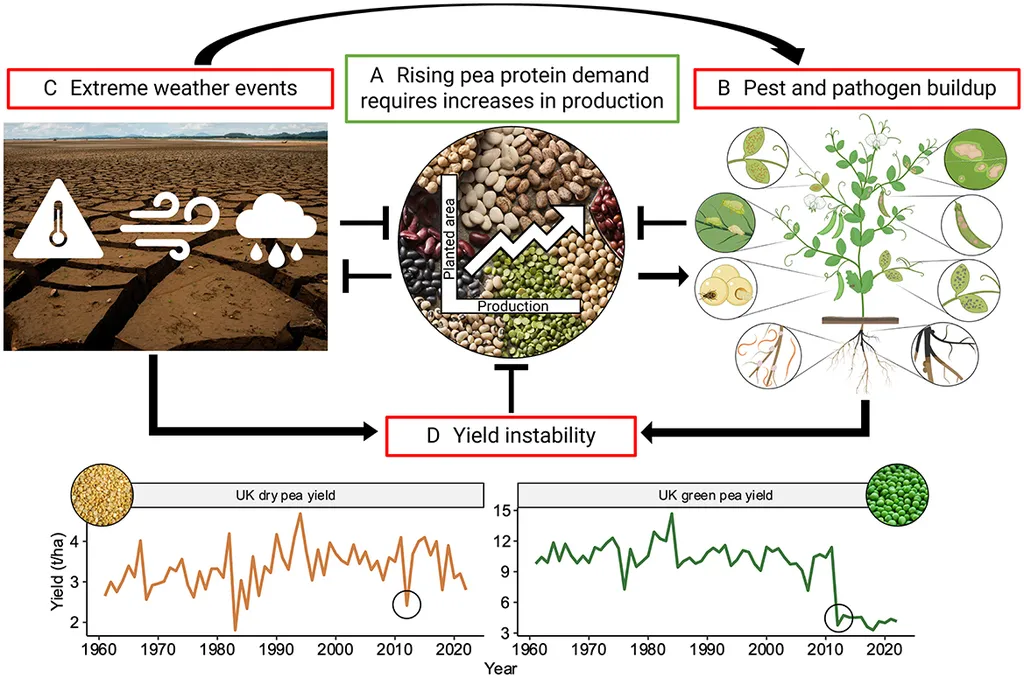
In a significant stride towards combating a major pea crop menace, researchers have identified new genomic regions associated with partial resistance to Aphanomyces root rot. This breakthrough, published in *The Plant Genome*, could revolutionize pea breeding programs and bolster the agriculture sector’s fight against this devastating pathogen.
Aphanomyces root rot, caused by *Aphanomyces euteiches*, is a formidable challenge for pea growers worldwide. With limited effective control strategies, developing resistant varieties is crucial. While partial resistance has been observed, its complex inheritance and the lack of understanding of soil pathogen populations have hindered progress.
To tackle this issue, a team led by Sara Rodriguez-Mena from the Institute for Sustainable Agriculture, CSIC in Córdoba, Spain, conducted a genome-wide association study (GWAS) on a previously unexplored pea collection. The study involved inoculating 323 pea accessions with the RB84 isolate of *A. euteiches* and assessing symptoms 20 days post-inoculation.
The GWAS revealed 27 significantly associated markers among a vast dataset of SilicoDArT and single-nucleotide polymorphism markers. These markers were distributed across the seven pea chromosomes, with a notable concentration on chromosomes 2 and 5, highlighting promising regions for future investigation.
“Our findings uncover new genomic regions linked with *A. euteiches* resistance,” Rodriguez-Mena explained. “This provides molecular markers and candidate genes to support precision breeding, which is a game-changer for the agriculture sector.”
The study identified 21 candidate resistance genes, offering a wealth of opportunities for developing resistant pea varieties. Notably, the newly identified quantitative trait loci (QTL) may prove more effective against specific isolates than known QTL, enabling improved QTL rotation in the field.
The commercial implications of this research are substantial. By providing breeders with precise genetic tools, this study could accelerate the development of resistant pea varieties, enhancing crop yields and reducing economic losses for farmers. Moreover, the insights gained from this research could extend to other legume crops, broadening its impact on the agriculture sector.
As the global demand for sustainable and resilient crops grows, this research offers a beacon of hope. By harnessing the power of genomics, the agriculture sector can better combat pathogens and secure food supplies for a burgeoning population.
In the words of Rodriguez-Mena, “This is just the beginning. The genetic diversity within pea collections is vast, and there’s so much more to explore. Our study opens doors to a future where precision breeding plays a pivotal role in sustainable agriculture.”
With the findings published in *The Plant Genome* and led by Sara Rodriguez-Mena from the Institute for Sustainable Agriculture, CSIC in Córdoba, Spain, this research marks a significant milestone in the ongoing battle against Aphanomyces root rot, paving the way for innovative and effective breeding strategies in the agriculture sector.