
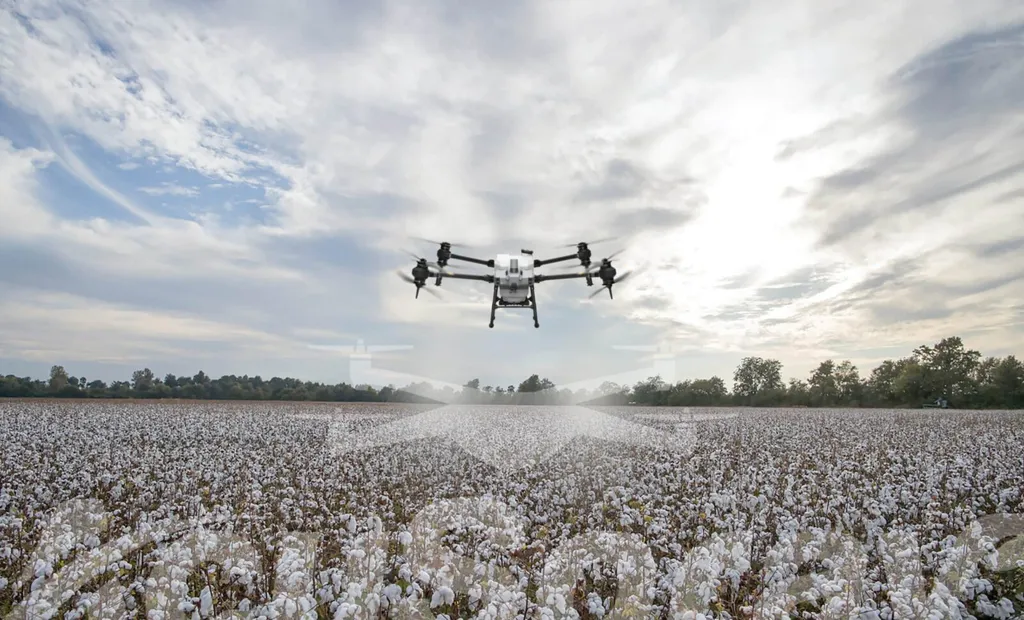
In the quest for precision agriculture, researchers have turned to the skies for a more accurate way to monitor crop nutrition. A recent study published in *Notulae Botanicae Horti Agrobotanici Cluj-Napoca* has demonstrated that integrating data from unmanned aerial vehicles (UAVs) can significantly enhance the accuracy of nitrogen content estimation in cotton crops. This breakthrough could revolutionize how farmers manage crop nutrition, leading to improved yields and quality.
Nitrogen is a critical nutrient for crop growth, development, and quality. Traditional methods of monitoring nitrogen levels often rely on single data sources, which can be limiting in terms of spatial coverage and information depth. However, the advent of UAV remote sensing technology has opened new avenues for more comprehensive and efficient crop monitoring. By integrating hyperspectral and digital imaging data, researchers can gain multi-angular insights that were previously unattainable.
The study, led by Mengxin Fan from Shihezi University College of Agriculture and The Key Laboratory of Oasis Ecoagriculture, Xinjiang Production and Construction Group, focused on ‘Xinluzao 53’ cotton. The researchers constructed four machine learning models: Ridge (RR), back-propagation neural network (BPNN), random forest (RF), and Bagging. These models were integrated with multilevel data fusion methods to obtain detailed nutrition information.
The results were promising. The random forest (RF) model, combined with the UAV ‘spectrum-image’ feature-level fusion framework, achieved a validation set R2 of 0.915 and an RMSE of 1.562. Meanwhile, the Bagging model, integrated with the decision-level fusion framework, achieved a validation set R2 of 0.923 and an RMSE of 1.488. These findings indicate that UAV-based ‘spectral-image’ multilevel fusion frameworks can significantly enhance the accuracy of nitrogen content monitoring.
“Our study demonstrates that integrating multiple data types from UAVs can provide a more comprehensive and accurate picture of crop nutrition,” said Fan. “This technology has the potential to transform precision agriculture by enabling farmers to make more informed decisions about nutrient management.”
The commercial implications of this research are substantial. Accurate nitrogen monitoring can lead to optimized fertilizer use, reducing costs and environmental impact while improving crop yields and quality. As precision agriculture continues to evolve, the integration of UAV technology and machine learning models could become a standard practice, benefiting farmers and the agriculture sector as a whole.
This study, published in *Notulae Botanicae Horti Agrobotanici Cluj-Napoca* and led by Mengxin Fan from Shihezi University College of Agriculture, represents a significant step forward in the field of agritech. By leveraging the power of UAVs and advanced data fusion techniques, researchers are paving the way for more efficient and sustainable agricultural practices. The future of precision agriculture looks brighter, thanks to these innovative approaches.