
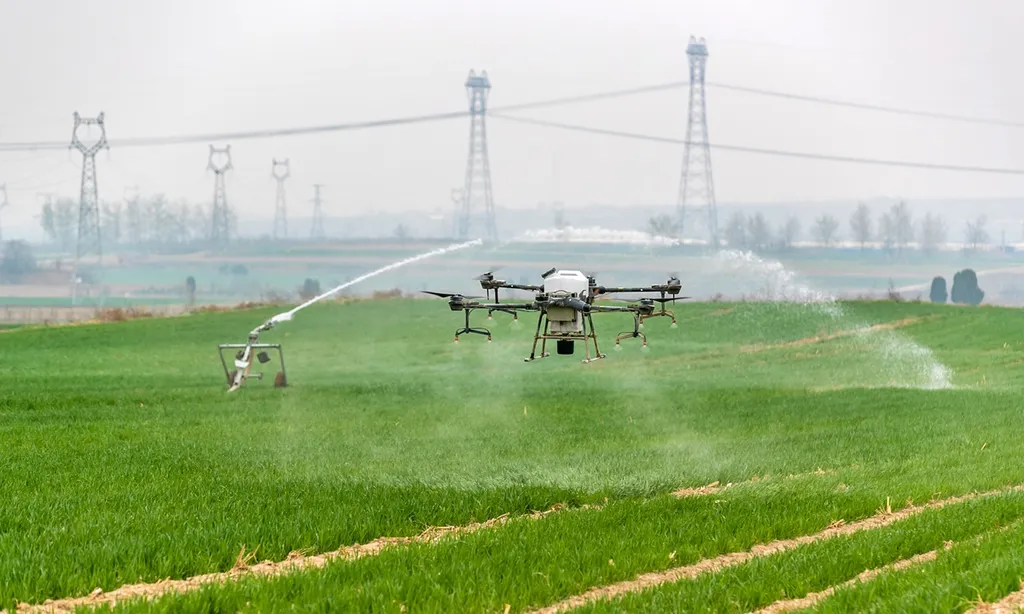
In the ever-evolving landscape of agricultural technology, a groundbreaking study published in *Scientific Reports* is set to revolutionize wheat growth monitoring. Led by Mingguang Diao from the School of Information Engineering at China University of Geosciences (Beijing), the research integrates satellite remote sensing and machine learning to create a more accurate and efficient system for tracking wheat growth. This innovation could have profound implications for farmers, agribusinesses, and global food security.
The study leverages Sentinel-2 satellite images and measured wheat leaf area index (LAI) data to construct a comprehensive index system. By selecting and ranking 11 vegetation indices—such as NDVI, NDRE, and RVI—through Pearson correlation analysis, the researchers identified the top eight indices to build their monitoring model. “The integration of these indices provides a more holistic view of wheat growth, allowing for more precise and reliable monitoring,” Diao explains.
To evaluate the performance of their index system, the team applied three machine learning models: Linear Regression (LR), Backpropagation Neural Network (BPNN), and XGBoost. Each model was optimized using the Particle Swarm Optimization (PSO) algorithm. The results were impressive, with the PSO-optimized XGBoost model achieving the highest accuracy (R² = 0.94, MSE = 0.075). This model demonstrated strong stability and robustness to data fluctuations, making it a reliable tool for agricultural decision-making.
The commercial impacts of this research are substantial. For farmers, this technology can lead to more informed decisions about irrigation, fertilization, and pest control, ultimately increasing crop yields and reducing costs. Agribusinesses can benefit from more accurate predictions of wheat growth, enabling better supply chain management and market planning. “This technology has the potential to transform the way we approach wheat cultivation, making it more efficient and sustainable,” Diao notes.
Looking ahead, this research could shape future developments in the field of agricultural technology. The integration of remote sensing and machine learning opens up new possibilities for monitoring other crops and agricultural practices. As the technology continues to evolve, it could become a standard tool in the agricultural sector, contributing to global food security and sustainability.
In a world where food security is a growing concern, this study offers a beacon of hope. By harnessing the power of technology, we can create a more resilient and efficient agricultural system, ensuring a stable food supply for future generations. The research led by Mingguang Diao, published in *Scientific Reports*, is a testament to the potential of agritech innovations to drive positive change in the agricultural sector.