
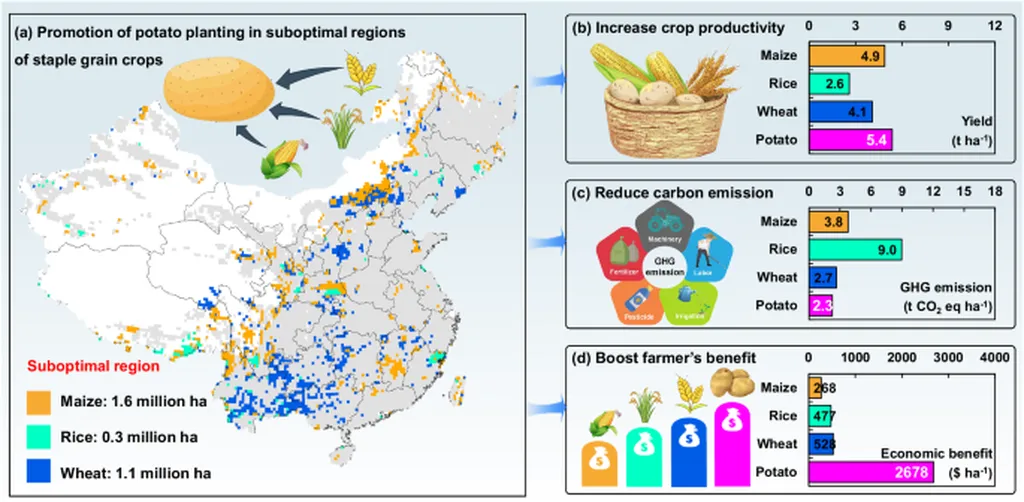
In the vast agricultural landscape of China, a humble tuber is making waves, promising to boost productivity, pad farmers’ pockets, and trim carbon emissions. Potatoes, often overshadowed by staple grains like wheat and maize, are stepping into the spotlight thanks to new research published in *Communications Earth & Environment*.
The study, led by Yang Li from the College of Resources and Environmental Sciences at China Agricultural University, identifies regions where grain crops underperform and compares the potential benefits of switching to potato cultivation. The findings are compelling: in these low-yield areas, potatoes could increase crop productivity by a staggering 2% to 119%. “This isn’t just about growing more food; it’s about growing smarter,” Li explains.
The economic implications are equally promising. Farmers in these regions currently see returns generally lower than $600 per hectare. But by switching to potatoes, they could see profits soar to over $1,600 per hectare. This shift could be a game-changer for small-scale farmers, offering a lifeline in areas where traditional crops have struggled.
But the benefits don’t stop at the farm gate. The study also highlights significant environmental advantages. Potato cultivation could lower greenhouse gas emissions by 6% to 85% and reduce emissions intensity by 26% to 92%. “This is a win-win scenario,” Li notes. “We can boost food production and economic returns while also doing our part for the environment.”
However, the research also acknowledges a trade-off. Switching to potatoes in low-yield wheat and maize regions could reduce calorie supply by over 70%. But Li is quick to point out that this reduction wouldn’t significantly impact overall caloric provision at the national level. “It’s about finding a balance,” he says. “And in this case, the benefits far outweigh the drawbacks.”
So, what does this mean for the future of agriculture in China? The research suggests that promoting potato cultivation in low-yield regions could be a strategic move, offering multiple benefits that enhance productivity, economic returns, and environmental sustainability. It’s a bold vision, but one that could reshape the agricultural landscape and secure food security for generations to come.
As the world grapples with the challenges of climate change and food security, this research offers a glimmer of hope. It’s a reminder that sometimes, the solutions we seek might be hiding in plain sight, waiting to be discovered and nurtured. And in this case, that solution comes in the form of a humble potato, ready to take its place at the table of staple crops.