
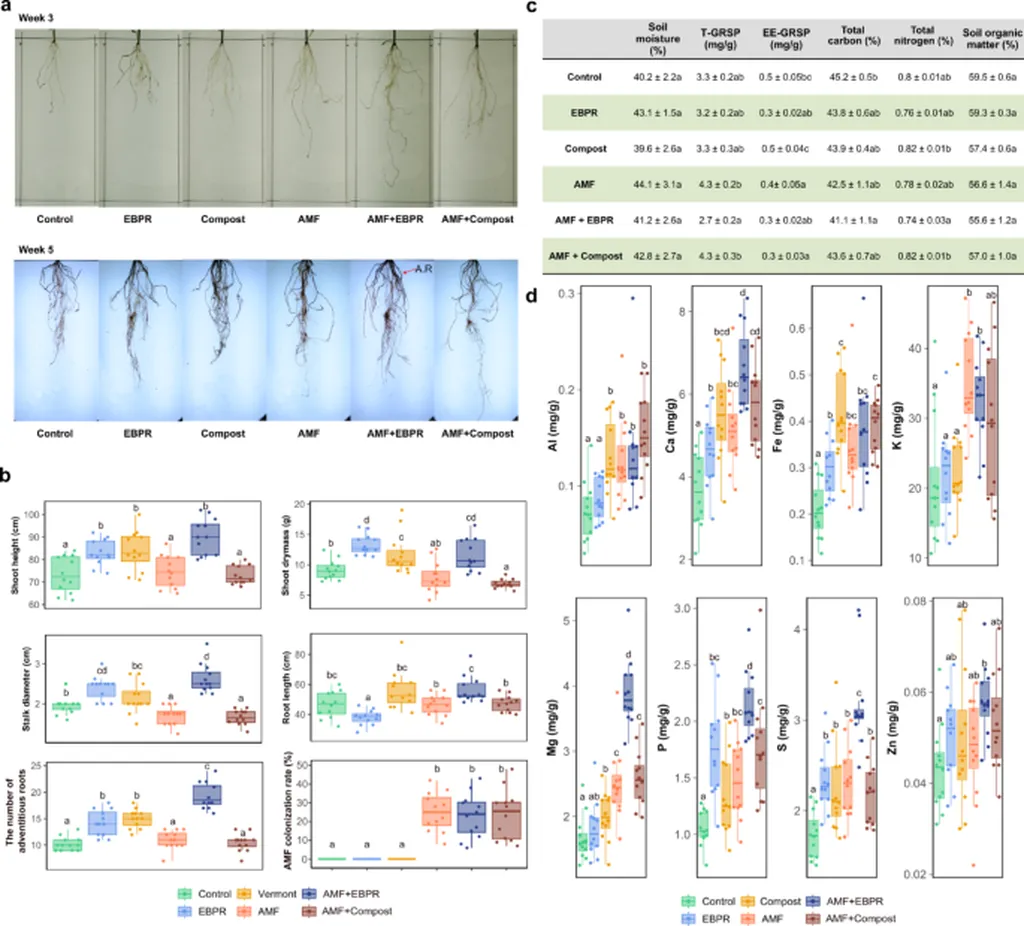
In the quest to revolutionize agriculture through sustainable practices, a groundbreaking study published in *Environmental Microbiome* has unveiled a promising avenue for enhancing crop productivity and soil health. Researchers, led by Yejin Son from the School of Integrative Plant Science at Cornell University, have discovered that integrating polyphosphate-accumulating organisms (PAOs) from enhanced biological phosphorus removal (EBPR) systems with arbuscular mycorrhizal fungi (AMF) can significantly boost nutrient uptake and growth in sorghum (*Sorghum bicolor*).
The study highlights the critical role of PAOs, which are known for their ability to sequester phosphorus from wastewater and store it as intracellular polyphosphate. However, their potential in terrestrial ecosystems has remained largely unexplored until now. By enriching the sorghum rhizosphere with PAOs derived from EBPR biosolids and compost, the researchers observed remarkable improvements in plant growth and nutrient dynamics.
“Our findings demonstrate that PAOs from EBPR systems can adapt to soil environments and form synergistic relationships with AMF,” Son explained. “This interaction not only enhances phosphorus uptake but also promotes microbial diversity and functionality in the rhizosphere.”
The research employed a multifaceted approach, including plant biometry analysis, nutrient assays, 31P NMR spectroscopy, single-cell Raman microspectroscopy (SCRS), and microbiome profiling. The results confirmed that AMF showed enhanced synergy with EBPR-derived microbiomes, leading to significant improvements in sorghum growth, nutrient acquisition, and microbial diversity.
Key PAOs such as *Thauera*, *Rhodanobacter*, and *Paracoccus* were successfully incorporated into the rhizosphere and were positively correlated with improved phosphorus uptake. PICRUSt2 analysis further revealed that EBPR-treated rhizospheres were enriched with microbial functions linked to motility and xenobiotic metabolism.
“This study opens up new possibilities for developing biofertilizers that leverage the synergistic effects of PAOs and AMF,” Son added. “By harnessing wastewater-derived phosphorus, we can create a more sustainable and circular approach to agriculture.”
The commercial implications of this research are substantial. As the agriculture sector increasingly seeks sustainable and cost-effective solutions, the integration of EBPR microbiomes with AMF offers a novel strategy for improving soil fertility and crop productivity. This approach not only supports regenerative agriculture but also aligns with the growing demand for nutrient circularity and microbial biofertilizers.
The study’s findings underscore the potential of targeted microbial co-inoculation as an innovative strategy for enhancing soil fertility and advancing biofertilizer development. By harnessing wastewater-derived phosphorus via PAOs, this approach offers a sustainable alternative to conventional fertilization, supporting regenerative agriculture, nutrient circularity, and the broader application of microbial biofertilizers in crop production.
As the agriculture sector continues to evolve, the integration of microbial synergies could pave the way for more resilient and productive farming practices, ultimately contributing to a more sustainable future.