
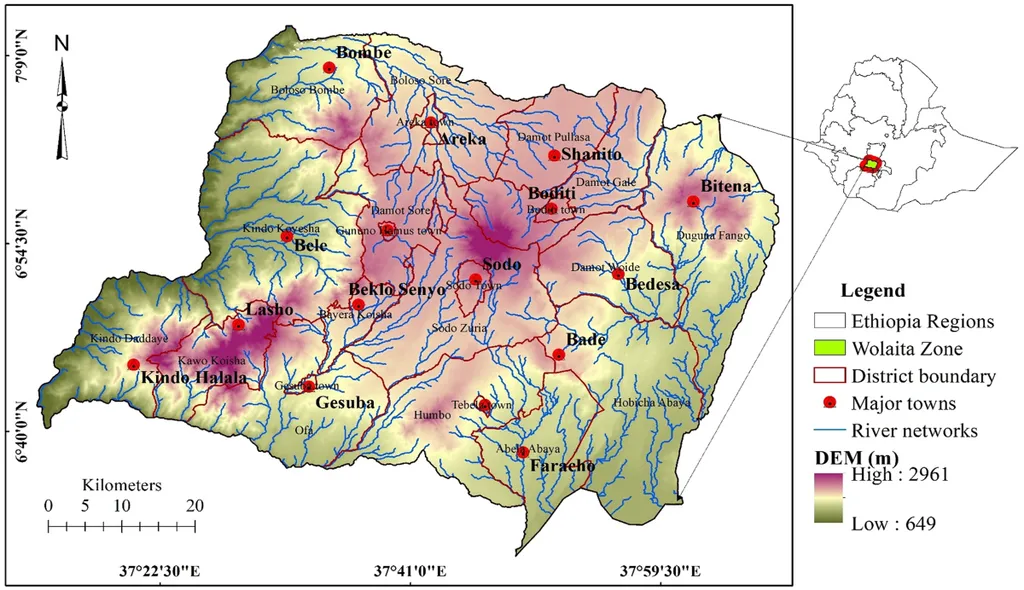
In the heart of Ethiopia’s Wolaita Zone, a remarkable ecological transformation is underway, one that could offer valuable lessons for sustainable agriculture and land management worldwide. A recent study published in *Environmental Systems Research* reveals that the region has experienced a significant increase in ecosystem service values (ESVs) over the past three decades, bucking the global trend of declining ESVs.
The research, led by Selemon Thomas Fakana of the Department of Environmental Science at Gambella University, utilized Landsat data from 1995 to 2025 to analyze land use and land cover (LULC) changes. By employing advanced remote sensing techniques and the Support Vector Machine (SVM) algorithm, the team was able to map and quantify the shifts in the landscape with remarkable accuracy.
The findings are striking. Between 1995 and 2025, vegetation cover and waterbodies in the Wolaita Zone increased by 512.61 km² (26.4%) and 66.57 km² (247.46%), respectively. This greening of the landscape has led to a substantial boost in ESVs, from US$246.75 million in 1995 to US$342.23 million in 2025—a net gain of US$95.48 million per year (38.7%).
“This increase in ecosystem services is not just an environmental win; it’s a boon for the agricultural sector,” says Fakana. “Healthy ecosystems support productive landscapes, which can enhance agricultural yields and resilience.”
The study highlights the importance of sustainable land use planning and ecological restoration. The expansion of vegetation suggests the effectiveness of afforestation efforts, while the growth of waterbodies underscores the significance of hydrological interventions and watershed protection. Notably, the construction of the Gilgel Gibe III hydroelectric dam has played a crucial role in this transformation.
For the agriculture sector, these findings could be a game-changer. As the world grapples with the impacts of climate change and land degradation, the Wolaita Zone’s experience offers a blueprint for enhancing productivity and sustainability. By investing in ecological restoration and conservation, farmers and land managers can improve soil health, water availability, and biodiversity, all of which are critical for long-term agricultural success.
“This research provides a roadmap for policymakers and land managers,” Fakana explains. “It shows that with the right interventions, we can achieve a win-win situation—improving both ecological health and agricultural productivity.”
The study’s robust methodology, including sensitivity analysis, ensures that the results are reliable and applicable to other regions facing similar challenges. As the world seeks sustainable solutions to feed a growing population, the lessons from Wolaita Zone could be instrumental in shaping future developments in agritech and land management.
In an era where environmental degradation often seems inevitable, the Wolaita Zone’s story is a beacon of hope. It demonstrates that with concerted effort and strategic planning, we can restore and enhance the ecosystems that support our livelihoods and well-being. As the global community strives to achieve the Sustainable Development Goals, this research offers a compelling case for investing in nature-based solutions.
For those in the agritech sector, the message is clear: sustainable land use planning and ecological restoration are not just environmental imperatives but also economic opportunities. By embracing these principles, the agriculture sector can secure a more resilient and productive future.