
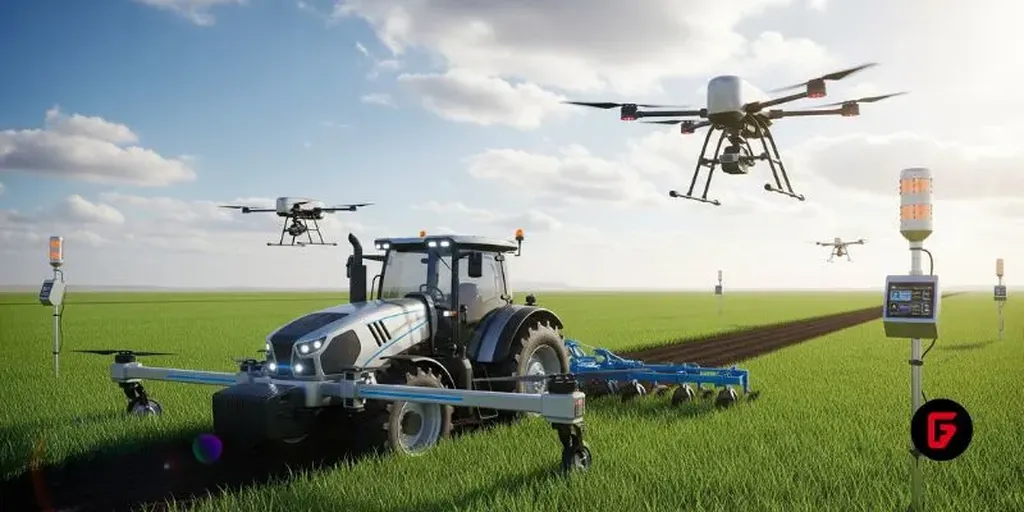
In the not-too-distant future, the sight of robots traversing rural fields could become as commonplace as that of combine harvesters and tractors, according to Professor Gerry Lacey. The robotics expert, along with his team of “enthusiastic young people,” are at the forefront of a series of experiments aimed at revolutionizing modern farming through the Automating Regenerative Agriculture (Aura) project at Maynooth University.
Using a hectare of land in County Kildare, the Aura project is exploring how robotics and Artificial Intelligence (AI) can enhance crop picking efficiency, improve weed management, and integrate solar panels into everyday farming operations. Professor Lacey emphasizes that technological advancements are crucial for addressing the impending challenge of feeding a growing global population. “By 2050, we’re going to have to feed 10 billion people, which means that we have to increase the amount of food on planet earth by 56% but we need to do that without using any more land,” he said. “We also need to do that while we reduce the emissions from agriculture.”
Despite the increasing population, there is a declining interest in agricultural work, contributing to “field waste” where viable produce is often destroyed or left behind during harvesting. “Frequently you’ll hear farmers saying, ‘Oh, well, we couldn’t find the people to harvest this crop, so it got ploughed back in,’” Professor Lacey noted. To combat this issue, the Aura project is developing AI and robotic solutions that can selectively pick fruits and vegetables when they are ripe, mimicking the traditional harvesting methods of our ancestors.
Currently, mechanical harvesting involves large machines that harvest an entire field at once, resulting in a mix of ripe, overripe, and unripe produce. However, one of the innovative machines being developed by the Aura project can pick individual fruits and vegetables with minimal energy consumption, ensuring optimal ripeness. Another traditional method being reimagined involves a robot using boiling water to weed crops. These technologies are designed to be maintainable by farmers themselves, as a breakdown during harvest could result in significant financial losses.
The project is also exploring the optimization of solar technology in Ireland, experimenting with vertical panels that can be installed in fields alongside crops. The Aura project has partnered with commercial organizations like Irish Distillers and Comex McKinnon to leverage the latest technology for creating more sustainable grains.
Una Parsons, an upcoming president of Engineers Ireland, highlights the agritech industry as a “huge opportunity” for Ireland, noting the country’s reputation for producing agricultural machinery and its thriving tech industry. Technological advancements can also attract younger generations to farming, helping to address labor shortages. “Every young kid is into their phone,” she said, suggesting that combining technology with farming could be a winning strategy.
Parsons points to Herdwatch, an AI-powered software management tool that helps farmers manage their herds, as an example of a successful agritech innovation. Used on 20,000 farms across Ireland, the US, and the UK, Herdwatch demonstrates the potential of agritech. However, Parsons advocates for more support for the sector, including the establishment of an intergovernmental task force to develop the agritech industry and making it a focus during Ireland’s presidency of the Council of the European Union next year.
In response, the Department of the Environment highlighted various projects and initiatives supporting the agritech space, such as the VistaMilk Research Centre, which aims to transform Ireland’s dairy sector into a global leader. The department also mentioned its involvement in agritech events that facilitate collaboration between researchers and industry executives from the US and Ireland.