
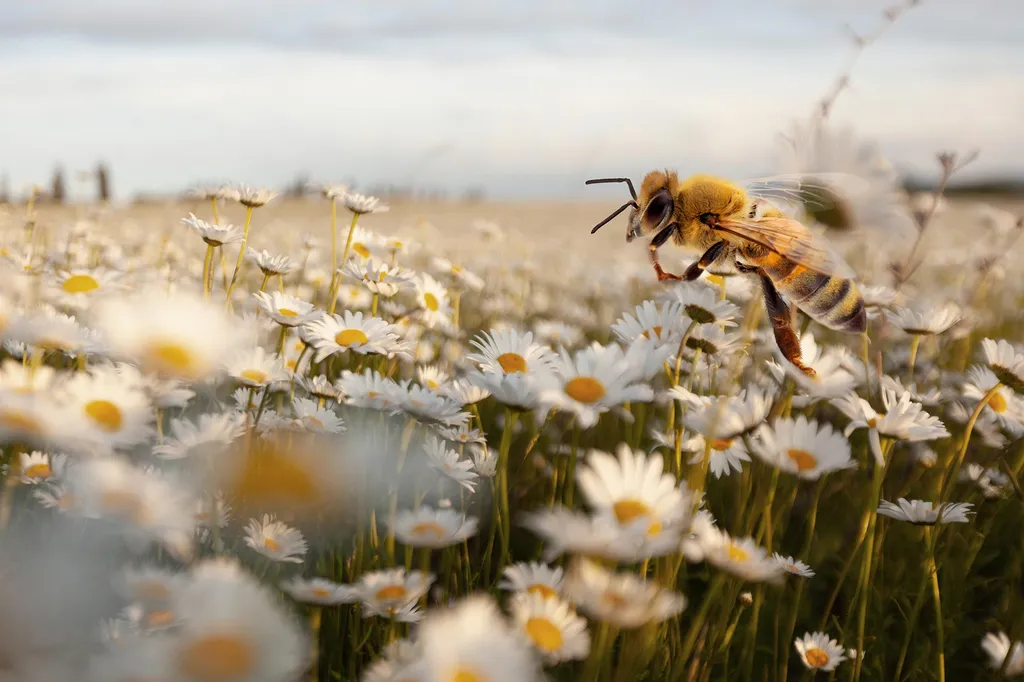
In the heart of Germany’s agricultural landscape, a novel approach to maize cultivation is buzzing with potential, quite literally. Researchers have found that undersowing maize with a diverse annual flower mixture can significantly boost the abundance and diversity of wild bees, offering a promising strategy to enhance biodiversity in intensively managed farmlands. The study, led by Hannah Weinläder from the Institute for Applied Agricultural Research at Nürtingen-Geislingen University, was recently published in the journal *Basic and Applied Ecology*.
The research, conducted across multiple sites in Baden-Württemberg, compared traditional maize monocultures with maize intercropped with flower mixtures. The results were striking, particularly for wild bees. “Undersowing maize with a flower mixture significantly increased wild bee abundance, species richness, and diversity compared to pure maize,” Weinläder explained. This finding is a beacon of hope for agricultural practices that strive to balance productivity with ecological sustainability.
While wild bees showed a robust positive response, the effects on ground beetles were less pronounced, with no significant differences observed between the cropping systems. Rove beetles, however, exhibited an intermediate response, with higher activity density under the undersowing system, although their species richness and diversity remained unchanged.
The study also compared these undersowing systems with traditional flower strips, which are well-established conservation measures. Flower strips supported even higher diversity per unit area across all insect groups, as well as higher abundance of wild bees and rove beetles. However, when considering a scenario with 5% flower strip coverage, the abundance of wild bees and rove beetles was lower compared to undersown maize. This suggests that while flower strips are effective, they may need to cover a larger area to match the benefits of undersowing for certain insect groups.
The implications for the agriculture sector are substantial. As biodiversity declines globally, driven largely by anthropogenic land use, finding ways to integrate ecological benefits into commercial farming practices is crucial. Maize, a staple crop occupying a large proportion of arable land in Germany, has often been criticized for its ecological impact. This research offers a practical solution that could be readily adopted by farmers looking to enhance habitat quality without compromising their yields.
“We see this as a complementary measure,” Weinläder noted. “It’s not about replacing existing conservation strategies but about integrating them into a broader, landscape-scale approach.” This holistic view could pave the way for more sustainable agricultural practices that support both productivity and biodiversity.
The study’s findings highlight the potential of undersowing maize with flower mixtures to enhance habitat quality in agricultural landscapes. By doing so, it opens up new avenues for farmers to contribute to biodiversity conservation while maintaining their economic viability. As the agricultural sector continues to grapple with the challenges of sustainability, such innovative practices could become a cornerstone of future farming strategies.
For the agriculture sector, the commercial impacts are clear. Farmers can adopt undersowing practices to meet growing consumer demand for sustainably produced crops, potentially accessing premium markets and securing long-term profitability. Additionally, enhancing biodiversity on farms can improve ecosystem services such as pollination and pest control, further benefiting agricultural productivity.
As the world looks towards more sustainable and ecologically friendly farming practices, this research provides a compelling case for the integration of undersowing systems into mainstream agriculture. It’s a step towards a future where productivity and biodiversity can coexist, benefiting both farmers and the environment.