
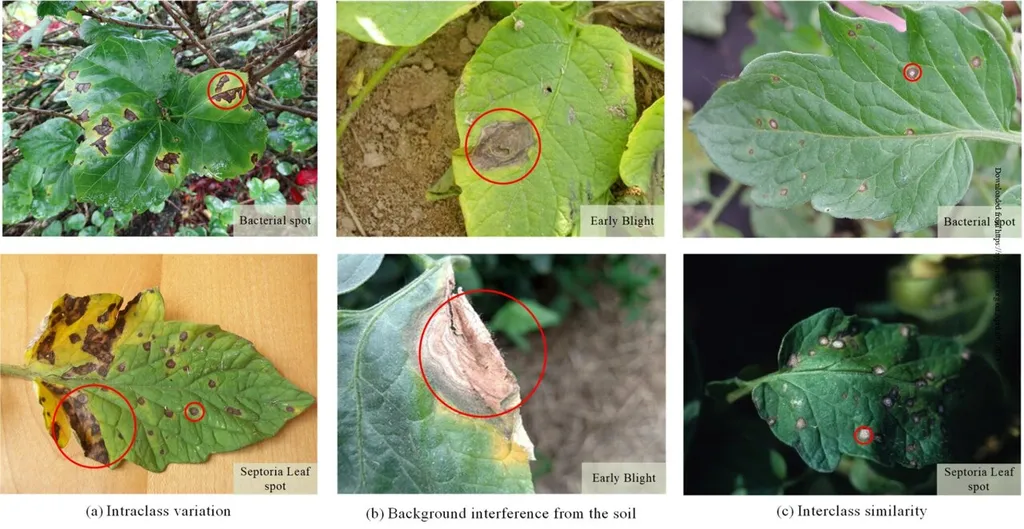
In the quest to bolster precision agriculture, researchers have made a significant stride in automating the diagnosis of tomato leaf diseases. A recent study published in the *Journal of Applied Informatics and Computing* introduces a multiclass classification model that leverages texture, color, and shape features, coupled with an optimized XGBoost algorithm, to identify tomato leaf diseases with remarkable accuracy.
The research, led by Fransisko Andrade Laiskodat from Universitas Amikom Yogyakarta, utilized the public PlantVillage dataset to train and test the model. The process involved several preprocessing stages, including feature extraction using the Gray-Level Co-Occurrence Matrix (GLCM), normalization, dimensionality reduction via Principal Component Analysis (PCA), and class balancing with the Synthetic Minority Over-sampling Technique (SMOTE). The model achieved an impressive accuracy of 97.63%, with both macro and weighted f1-scores of 0.98, demonstrating its potential to revolutionize plant disease diagnostics.
“Our model successfully classified ten different disease classes, which is a significant improvement over previous methods,” Laiskodat explained. “This level of accuracy is crucial for early detection and treatment, which can greatly enhance crop yields and reduce economic losses for farmers.”
The implications for the agriculture sector are substantial. Automated disease diagnosis can lead to more efficient use of pesticides, reduced crop losses, and improved overall farm management. “Precision agriculture is the future, and tools like this can make a real difference in how we approach plant health,” Laiskodat added.
The study highlights the effectiveness of combining handcrafted features with advanced machine learning algorithms. This approach not only offers a robust solution for disease diagnosis but also paves the way for further advancements in agricultural technology. As the field of precision agriculture continues to evolve, such innovations are expected to play a pivotal role in shaping the future of farming.
The research was published in the *Journal of Applied Informatics and Computing*, with Fransisko Andrade Laiskodat from Universitas Amikom Yogyakarta serving as the lead author. This work underscores the potential of integrating cutting-edge technology with traditional agricultural practices to create more sustainable and efficient farming systems.