
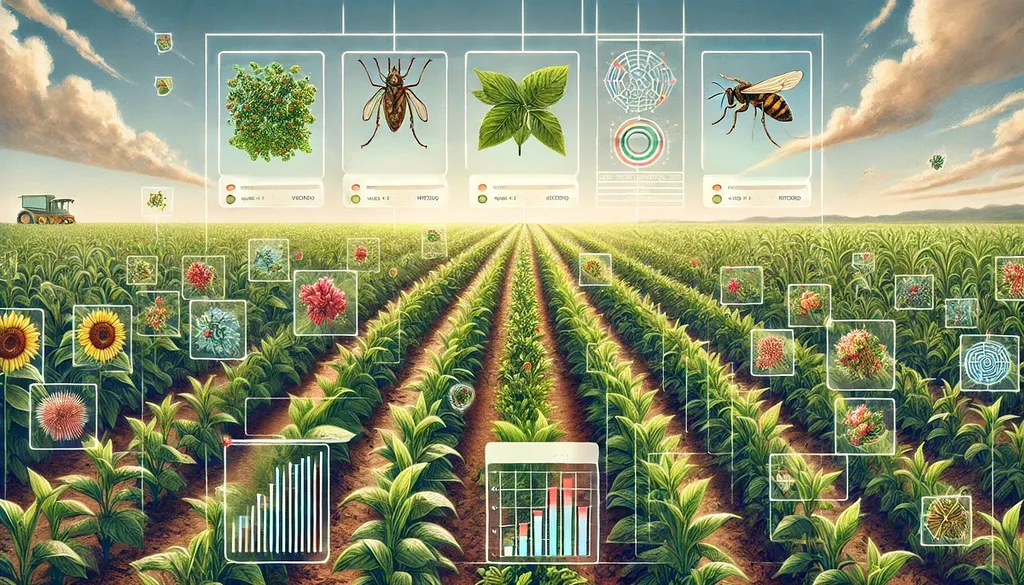
In the heart of Africa and other resource-constrained regions, smallholder farmers face an uphill battle against crop diseases, which threaten food security and livelihoods. A new review published in *IEEE Access* sheds light on how artificial intelligence (AI) could revolutionize disease detection in these complex farming environments, offering hope for more sustainable and inclusive agricultural practices.
The review, led by Rosemary Nalwanga of the Faculty of Electrical Engineering, Mathematics and Computer Science at the University of Twente in the Netherlands, explores the latest advancements in AI-based crop disease detection, with a particular focus on multi-crop and intercropped systems. Unlike previous studies that have concentrated on single-crop scenarios, this research takes a holistic approach, integrating multi-crop, multimodal, and edge-deployable perspectives.
“Most existing approaches are tailored to single-crop scenarios and rely on cloud-based or high-resource environments, limiting their applicability in the field,” Nalwanga explains. “Our review aims to bridge this gap by highlighting the technical challenges and identifying key research opportunities for scalable solutions.”
The detection pipeline, as outlined in the review, begins with data acquisition and preprocessing, followed by model training and deployment. However, the journey is fraught with challenges, including dataset scarcity, lack of modality diversity, poor model generalization, and limited real-world validation. These hurdles have historically hindered the development of effective disease detection systems for intercropping, a common practice among smallholder farmers.
One of the most promising avenues for future development, according to the review, is the integration of lightweight, multimodal models that can operate in offline-capable, edge-deployable environments. This approach would enable real-time disease detection and diagnosis in low-connectivity areas, empowering farmers to take early action and mitigate crop losses.
Moreover, the review suggests that the integration of conversational AI could provide field-level support, offering farmers personalized advice and guidance. “By centering on the realities of low-connectivity, heterogeneous farming environments, this review aims to offer guidance toward inclusive and sustainable AI-driven agriculture,” Nalwanga states.
The commercial impacts of this research could be profound, particularly for the agriculture sector. By developing scalable, AI-driven solutions tailored to the needs of smallholder farmers, we can enhance crop productivity, improve food security, and foster economic growth in resource-constrained regions.
As we look to the future, the insights gleaned from this review could shape the development of next-generation agricultural technologies, paving the way for a more sustainable and inclusive global food system. With continued research and innovation, AI has the potential to transform the way we detect and manage crop diseases, ultimately benefiting farmers and consumers alike.
The review, published in *IEEE Access*, offers a comprehensive overview of the current state of AI-based crop disease detection and provides a roadmap for future developments in this critical field.