
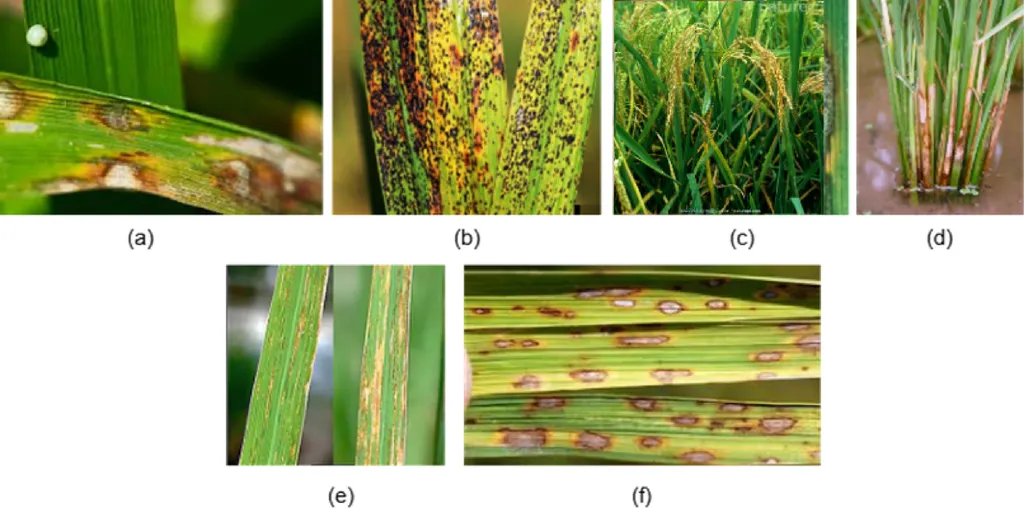
In the heart of Indonesia’s rice paddies, a silent battle rages—one that threatens the livelihoods of millions and the food security of nations. Rice leaf diseases, insidious and often undetected until it’s too late, can decimate crops and slash productivity. But a beacon of hope has emerged from the laboratories of Universitas PGRI Semarang, where researchers have harnessed the power of artificial intelligence to turn the tide in this age-old struggle.
A groundbreaking study, published in the *Journal of Applied Informatics and Computing*, has demonstrated the potential of deep learning models to revolutionize rice disease detection. Led by Tri Wahyu Utami, the research team developed an automated system capable of identifying eight distinct rice leaf diseases with remarkable accuracy. The system leverages Convolutional Neural Networks (CNNs) and transfer learning, utilizing pre-trained models to achieve unprecedented levels of precision.
The study compared the performance of a baseline CNN model with three state-of-the-art transfer learning models: EfficientNetB0, MobileNetV2, and ResNet50. The results were striking. While the baseline CNN model achieved a test accuracy of 48.26%, the transfer learning models outperformed it significantly. EfficientNetB0 reached 58.41%, but it was MobileNetV2 and ResNet50 that truly shone, with test accuracies of 79.98% and 76.60%, respectively. “MobileNetV2 exhibited the most balanced performance across all classes, showing superior generalization capability and computational efficiency,” Utami noted, highlighting the model’s potential for real-world applications.
The implications for the agriculture sector are profound. Early and accurate detection of rice leaf diseases can prevent widespread crop damage, ensuring higher yields and greater food security. For farmers, this technology could mean the difference between prosperity and penury. “This study highlights the potential of lightweight deep learning models for practical implementation in smart agriculture systems,” Utami explained, underscoring the transformative potential of these tools.
The researchers integrated the best-performing model into a Streamlit-based application, enabling real-time disease detection through simple image uploads. This user-friendly interface could empower farmers, agronomists, and agricultural extension workers to monitor crops more effectively, making informed decisions that could save entire harvests.
The study’s findings suggest that transfer learning models, particularly MobileNetV2, offer a robust and efficient solution for automated disease detection. As the world grapples with the challenges of climate change and a growing population, such technologies become increasingly vital. “This research provides a reliable solution for automated rice disease detection in real-world conditions,” Utami stated, emphasizing the practical applications of their work.
The research not only advances the field of agricultural technology but also paves the way for future developments. As deep learning models become more sophisticated and accessible, their integration into smart agriculture systems could revolutionize how we monitor and manage crops. The study’s success with MobileNetV2, in particular, suggests that lightweight, efficient models could be the key to scalable, real-time disease detection.
In the quest for food security and sustainable agriculture, this research offers a glimpse into a future where technology and tradition converge to create a more resilient and productive farming landscape. As the world watches, the paddies of Indonesia may well become the testing ground for a new era of smart agriculture, one where the power of AI helps to nourish the planet.