
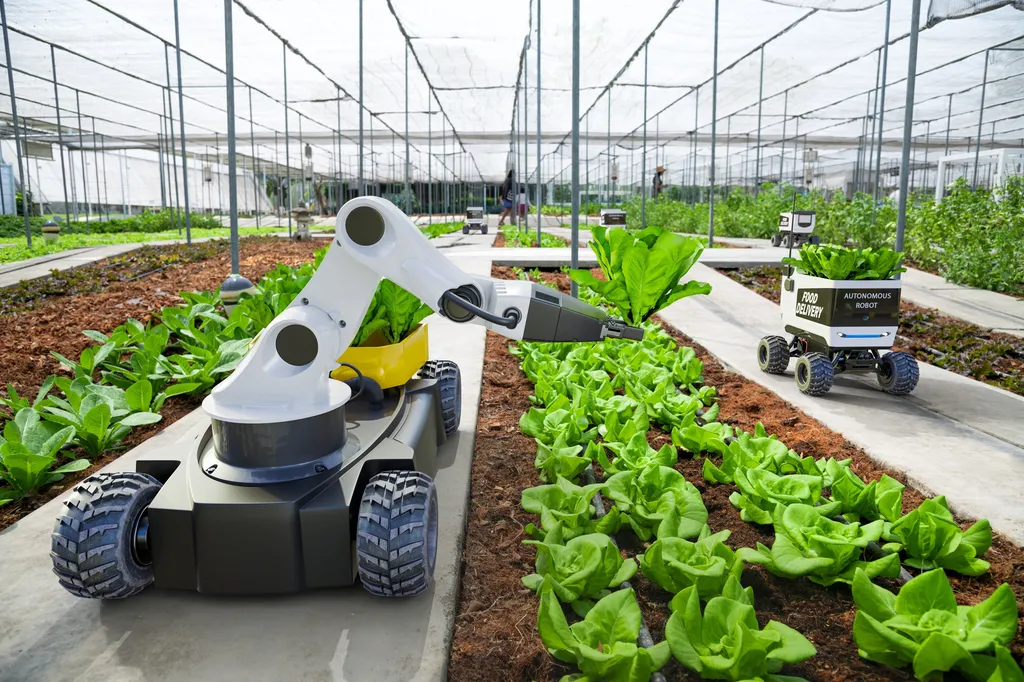
In the ever-evolving landscape of agricultural technology, a groundbreaking study published in *IEEE Access* is set to redefine the capabilities of autonomous machinery. Led by Runkun Guo of the Shanxi Institute of Mechanical and Electrical Engineering in Changzhi, China, the research introduces a perception-driven control framework designed to enhance the adaptability and efficiency of agricultural automation.
The study addresses a critical gap in current autonomous control systems, which often struggle with operational uncertainties, heterogeneous terrain conditions, and spatiotemporal variability. Traditional systems rely on rigid architectures or static policies, limiting their ability to adapt to environmental changes and multi-phase task requirements. “Conventional systems frequently exhibit limitations in handling sensor noise, occlusion, and terrain-dependent constraints due to insufficient modularity and inadequate multi-scale reasoning,” Guo explains. To overcome these challenges, the researchers propose an integrated framework combining the Field-Adaptive Perception-Control Encoder (FAPCE) and the Contextually Guided Adaptive Modulation (CGAM) system.
FAPCE utilizes a hierarchical encoder-decoder architecture to integrate multi-resolution sensory data, spatial field maps, and temporal sequences, enabling precise low-level control commands. CGAM incorporates semantic field classification, phase-aware control adaptation, and uncertainty-aware decision modulation to dynamically adjust control outputs based on contextual information. This approach facilitates real-time policy switching, smooth control transitions, and effective coordination among multiple agents, enhancing robustness in variable and unpredictable conditions.
The implications for the agriculture sector are profound. Autonomous machinery equipped with this framework can navigate diverse and dynamic environments with greater precision and efficiency, leading to improved coverage, safety, and task execution continuity. “Our system significantly improves coverage efficiency, safety compliance, and task execution continuity across diverse agricultural and semi-structured environments,” Guo notes. This advancement could revolutionize farming practices, particularly in large-scale operations where terrain variability and environmental uncertainties are common.
Extensive experiments across four benchmark datasets demonstrate the system’s superiority. The proposed method achieves an average accuracy of 92.17% and an F1 score of 90.90%, outperforming state-of-the-art baselines such as Swin Transformer and EfficientNet by 2.3% and 4.2%, respectively. Under sensor perturbations and partial modality loss, the system maintains over 89% F1 score, confirming its robustness. On embedded platforms such as NVIDIA Jetson Xavier, real-time inference is sustained at 17.8 FPS with a 23W power envelope, supporting practical deployment.
The commercial impact of this research is substantial. Farmers and agricultural businesses stand to benefit from increased productivity and reduced operational costs. The ability to deploy autonomous machinery that can adapt to varying conditions and tasks without human intervention opens up new possibilities for precision agriculture. This could lead to more efficient use of resources, reduced environmental impact, and higher crop yields.
As the agriculture sector continues to embrace technological advancements, the integration of perception-driven control strategies into autonomous machinery represents a significant step forward. The research led by Runkun Guo not only addresses current limitations but also paves the way for future developments in adaptive automation. By enhancing the capabilities of autonomous systems, this framework contributes to the broader goal of creating more sustainable and efficient agricultural practices.