
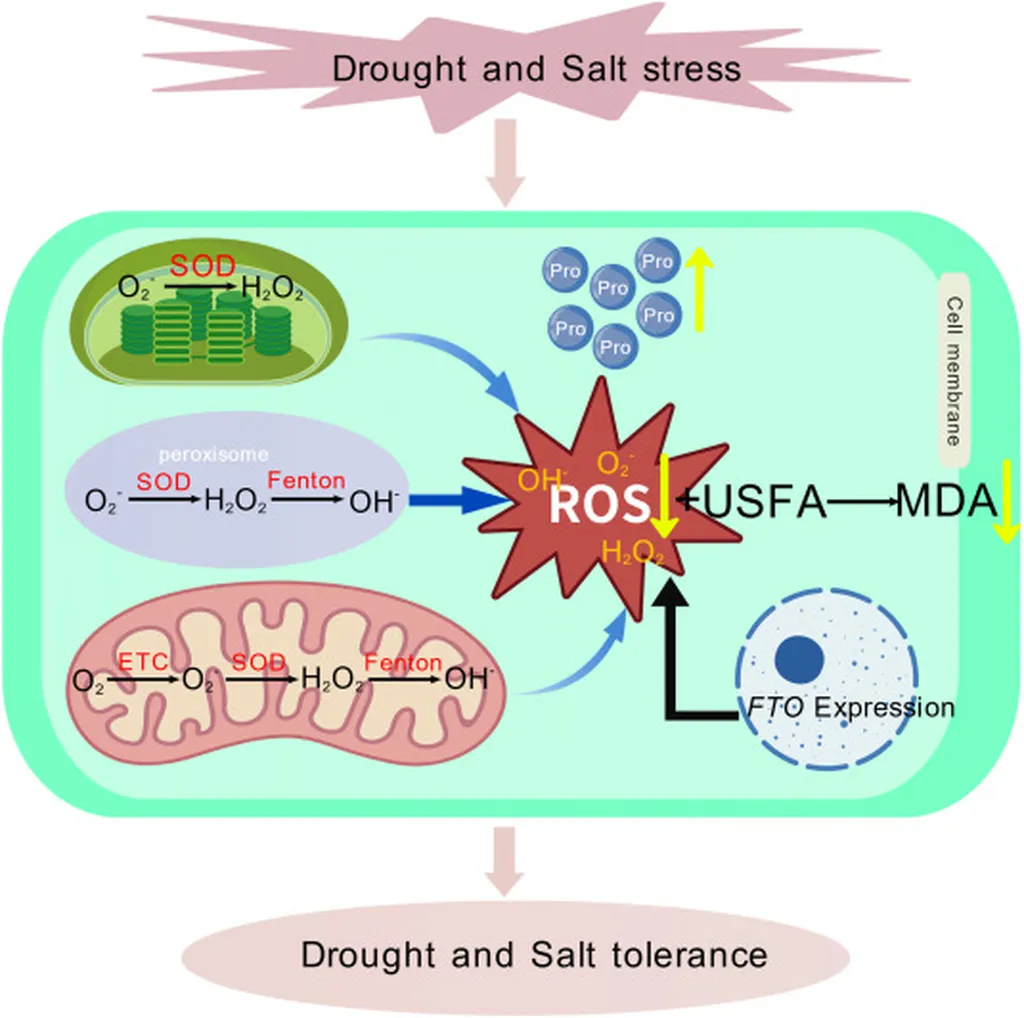
In a groundbreaking study published in *Oil Crop Science*, researchers have uncovered a promising avenue for enhancing the resilience of rapeseed (Brassica napus) against drought and salt stress, two of the most significant abiotic challenges faced by farmers worldwide. The study, led by Yuting Zou from the College of Agriculture at Yangtze University and the Oil Crops Research Institute of the Chinese Academy of Agricultural Sciences, explores the role of the human-derived FTO gene in improving plant stress tolerance.
The FTO gene, known for its involvement in mRNA demethylation, has been previously linked to increased plant biomass. However, its potential to bolster stress resistance has remained largely unexplored until now. Zou and her team cloned the FTO gene and conducted a series of experiments to assess its impact on drought and salt tolerance in Arabidopsis thaliana, a model organism for plant studies, and subsequently in rapeseed.
The results were striking. When the FTO gene was overexpressed in Arabidopsis, the transgenic lines exhibited significantly enhanced tolerance to both drought and salt stress. “The inhibitory effect of salt and drought stress on the root length growth of transgenic lines was markedly lower than that of the control,” noted Zou. This improved resilience was accompanied by a decrease in malondialdehyde (MDA) content, a marker of oxidative stress, and an increase in proline content and superoxide dismutase (SOD) activity, both of which are indicative of enhanced stress defense mechanisms.
The team then heterologously expressed the FTO gene in rapeseed, observing similar beneficial effects. Transgenic rapeseed plants showed significantly lower MDA levels and higher proline content and SOD activity compared to control plants. Furthermore, staining results with Trypan blue and nitroblue tetrazolium (NBT) revealed that the FTO gene could alleviate damage to plants under stress and inhibit the accumulation of reactive oxygen species, such as superoxide (O2−).
The implications of this research for the agriculture sector are substantial. Drought and salt stress are major constraints to crop productivity, particularly in arid and semi-arid regions. By enhancing the stress tolerance of rapeseed, a crucial oilseed crop, this study paves the way for developing more resilient crop varieties that can thrive in adverse environmental conditions. “Our findings provide valuable references for further exploring the FTO-mediated stress resistance mechanisms,” said Zou, highlighting the potential for future research and application.
The study not only sheds light on the role of the FTO gene in plant stress resistance but also opens up new possibilities for genetic engineering and crop improvement. As climate change continues to exacerbate abiotic stresses, the development of stress-tolerant crop varieties will be crucial for ensuring food security and agricultural sustainability. This research, published in *Oil Crop Science* and led by Yuting Zou, represents a significant step forward in this direction, offering hope for a more resilient and productive future for the agriculture sector.