
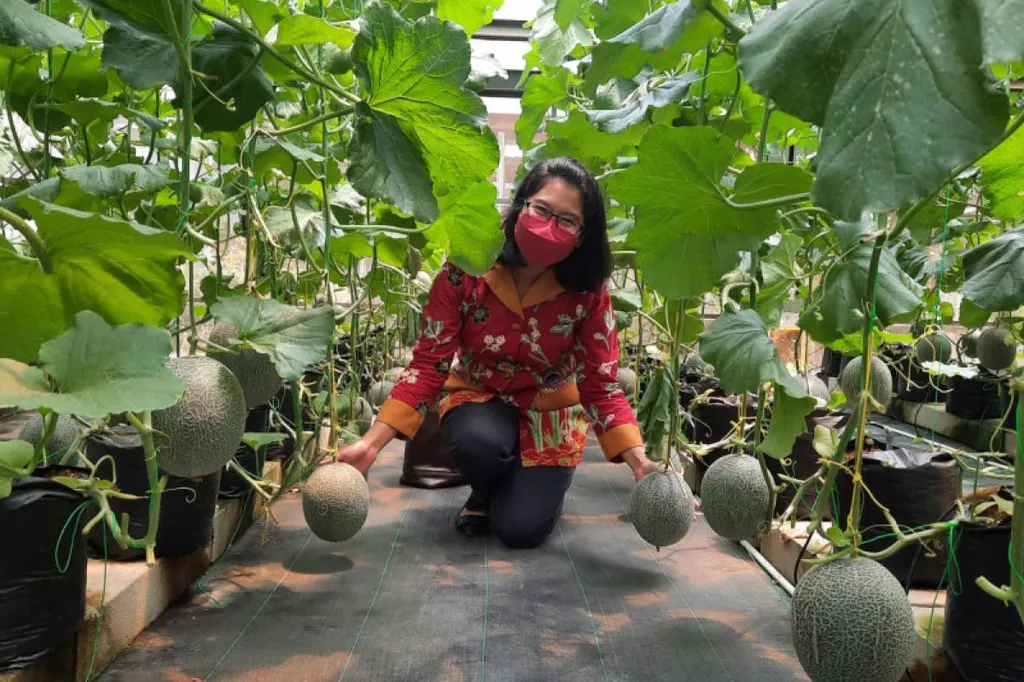
In the heart of Indonesia, researchers are pioneering a smarter way to grow melons, combining the precision of fuzzy logic with the connectivity of the Internet of Things (IoT). This innovative approach to irrigation could reshape how farmers manage water resources, particularly in controlled environments like greenhouses.
The team, led by Muhammad Sufi Nur Alif from Universitas Telkom, has developed an IoT-based smart drip irrigation system that uses Takagi-Sugeno fuzzy logic to fine-tune water delivery for melon plants. The system is a symphony of sensors and actuators: a capacitive soil moisture sensor and a DS18B20 temperature sensor feed real-time data to an ESP8266 microcontroller, which then controls a solenoid valve to regulate water flow. This data is also transmitted to a cloud platform, allowing farmers to monitor and adjust irrigation remotely.
“The system dynamically adjusts the solenoid valve opening duration from 0 to 720 seconds per irrigation session based on soil moisture and temperature inputs,” Alif explains. This precision helps maintain soil moisture within the optimal range of 60%–80%, a critical factor for melon cultivation.
The potential commercial impacts of this research are substantial. With water scarcity becoming an increasingly pressing issue, efficient irrigation systems are more important than ever. This smart system could help farmers reduce water waste, lower operational costs, and potentially increase yields. Moreover, the system’s scalability means it could be adapted for use with other crops and in various agricultural settings.
However, the journey towards fully optimized melon cultivation is not without its challenges. While the system effectively maintains soil moisture, plant growth evaluation revealed that additional factors such as soil conditions, humidity, and nutrient availability also play significant roles in plant health. “The system has not fully promoted healthy development, particularly in plant height and leaf width,” Alif acknowledges. This highlights the need for a holistic approach to agriculture, integrating multiple technologies and strategies to support plant growth.
Looking ahead, this research opens up exciting possibilities for the future of agriculture. As Alif notes, “The proposed smart irrigation system shows strong potential for further refinement to enhance water efficiency and support sustainable melon cultivation.” Future developments could see the integration of additional sensors to monitor a wider range of environmental factors, or the incorporation of machine learning algorithms to predict and respond to plant needs even more accurately.
This research, published in the Journal of Applied Informatics and Computing, is a testament to the power of interdisciplinary innovation. By bridging the gap between technology and agriculture, it paves the way for a more sustainable and efficient future for farming. As the world grapples with the challenges of climate change and resource depletion, such advancements are not just welcome, but essential.