
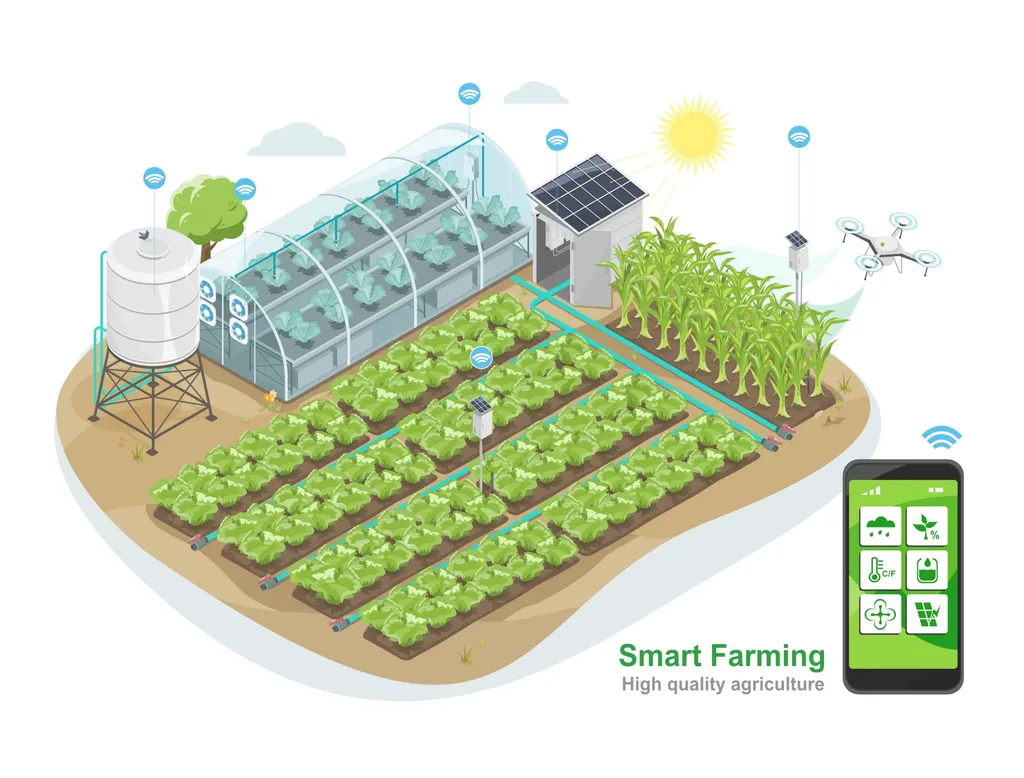
In the heart of Indonesia, researchers have been cultivating a revolution in agriculture, one lettuce leaf at a time. A team led by Okky Putra Barus from Universitas Pelita Harapan has harnessed the power of the Internet of Things (IoT) to create a smart indoor farming system that’s not just about growing crops, but growing them better, faster, and more efficiently than ever before.
The system, detailed in a study published in *Applied Computer Science*, employs a network of IoT sensors to monitor key environmental parameters in real-time. Temperature, humidity, nutrient solution pH, and concentration are all kept in check by a rule-based expert system that dynamically adjusts thresholds for automated control. This isn’t just about maintaining a comfortable environment for the plants; it’s about creating the optimal conditions for growth.
Over a 35-day growth cycle, the results were impressive. The smart indoor farming system outperformed traditional outdoor farming, with average increases of 17.1% in plant weight, 16.9% in plant height, and a 20.0% increase in the number of leaves. “The IoT-based control system robustly maintained environmental parameters within optimal ranges, creating a stable and conducive growth environment,” Barus explained. This stability and precision are key to the system’s success.
The implications for the agriculture sector are significant. As the world’s population continues to grow, so does the demand for food. Traditional farming methods are struggling to keep up, but smart indoor farming could be the solution. By optimizing growth conditions, these systems can increase yield and quality, all while using less water and space than traditional farms.
But the benefits don’t stop at increased yield. Smart indoor farming also offers greater control over the growing environment, reducing the risk of crop failure due to adverse weather conditions or pests. This could be a game-changer for farmers in regions with unpredictable climates or those looking to grow crops out of season.
Looking to the future, this research paves the way for further developments in smart farming. As IoT technology continues to advance, so too will our ability to monitor and control the growing environment. We could see systems that not only monitor and control environmental parameters but also predict and prevent potential issues before they arise.
Barus and his team’s work is a testament to the power of data-driven control and environmental monitoring. It’s a glimpse into the future of agriculture, where technology and nature work hand in hand to feed the world. As we stand on the brink of a new agricultural revolution, one thing is clear: the future of farming is smart, it’s connected, and it’s here.