
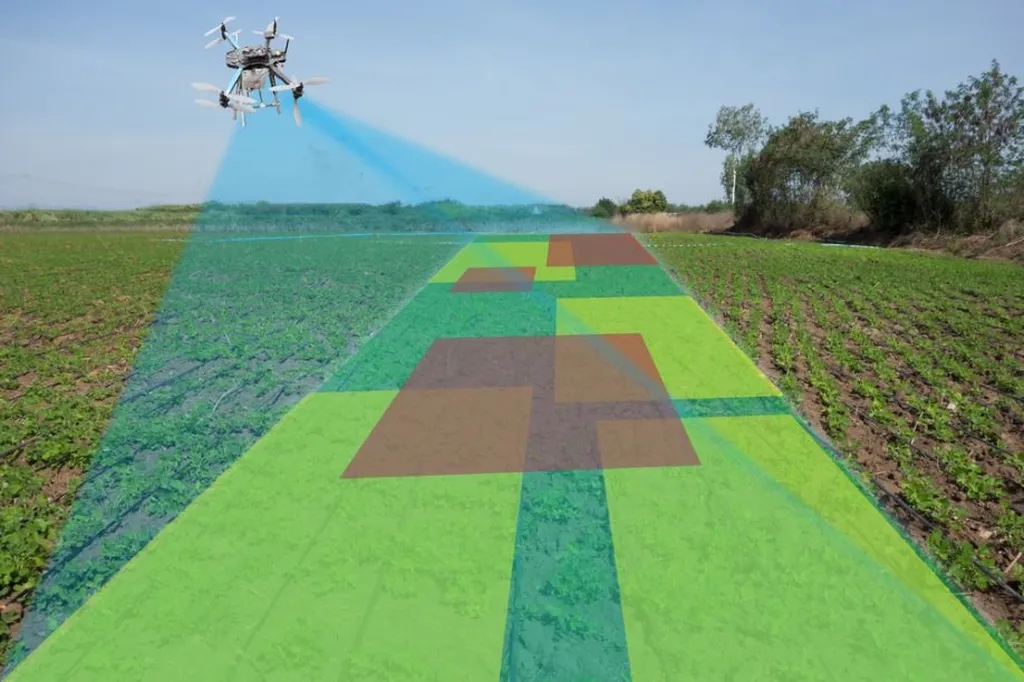
In the rapidly evolving world of agritech, precision is paramount. A recent study published in *The International Archives of the Photogrammetry, Remote Sensing and Spatial Information Sciences* has shed light on the accuracy and reliability of low-cost laser scanners, potentially revolutionizing how farmers and agritech companies approach field mapping and monitoring. The research, led by B. Mitka from the Dept. of Rural Land Surveying, Cadastre and Photogrammetry at the University of Agriculture in Krakow, offers a validated procedure for assessing the accuracy of scanning heads, with a specific focus on the Livox MID-360 scanners.
The study, conducted in the laboratory of the Faculty of Environmental Engineering and Geodesy, involved a meticulous process. Each of the 35 Livox MID-360 heads was tested in six angular poses, with three sets of 2 million points collected per pose, totaling 6 million points per head. The data was then registered to a reference point cloud generated by a Leica P40 scanner, followed by a Cloud-to-Cloud comparison that decomposed errors into X, Y, and Z components. The results were rasterized with a 0.25 m grid, allowing for a detailed analysis of error dependence on distance.
The findings are promising for the agriculture sector. “Measurement errors fall within the manufacturer-declared range for all examined units, indicating the suitability of the heads for centimeter-precision tasks,” Mitka explained. This level of accuracy is crucial for applications such as precision agriculture, where detailed field mapping and monitoring can lead to more efficient use of resources, improved crop yields, and better land management.
However, the study also identified some nuances. A small step-like change in error in the Z direction was observed at distances of approximately 10–12 meters from the scanner, along with minor direction-dependent differences in the distributions in the X and Y directions. These findings highlight the importance of understanding the limitations and characteristics of the scanning technology to ensure optimal performance in real-world applications.
The proposed procedure provides practical recommendations for quality control, which could be invaluable for agritech companies looking to integrate low-cost scanners into their operations. The results also serve as a reference point for calibration and deployment, potentially shaping future developments in the field.
As the agriculture sector continues to embrace technology, the insights from this research could pave the way for more accurate and efficient scanning systems. By understanding the strengths and limitations of low-cost scanners, farmers and agritech companies can make informed decisions that drive innovation and improve productivity. The study not only validates the performance of the Livox MID-360 scanners but also sets a standard for future research and development in the field of 3D scanning systems.