
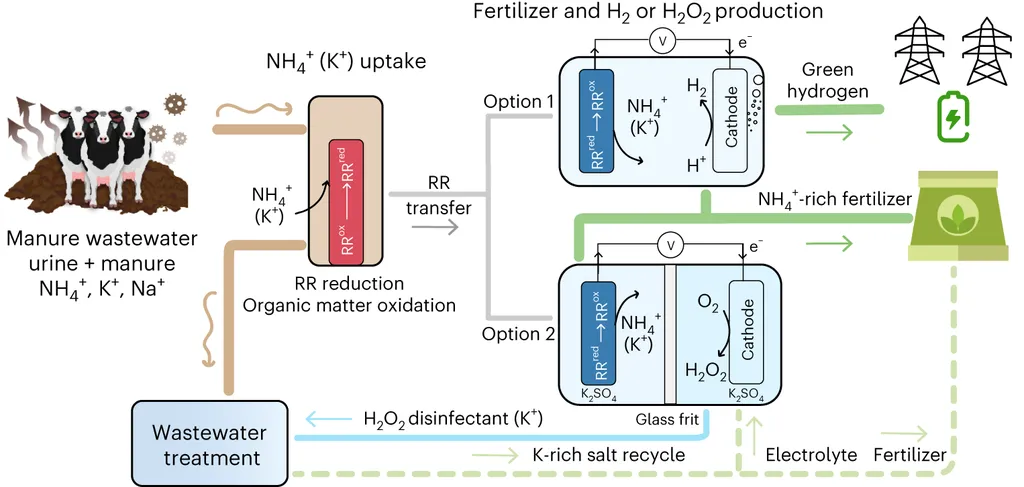
In the quest for sustainable agriculture, scientists are turning to innovative technologies to close the nitrogen cycle, and a recent study published in *Carbon Future* offers a promising avenue. Researchers, led by Rui Wang from the Department of Chemistry at Northwestern University, have explored the use of redox-active materials for electrochemical ammonia recovery, a method that could revolutionize how we recycle nitrogen from waste streams.
Ammonia recovery is crucial for reducing environmental pollution and creating a more sustainable agricultural sector. Traditional methods often rely on expensive ion-exchange membranes, but this new approach leverages redox-active materials, such as Prussian blue analogs, to selectively uptake ammonia without these costly components. “Using redox-active materials allows for selective ammonia uptake driven by renewable electricity or even spontaneously through the oxidation of organic matter in manure wastewater,” Wang explains. This could significantly lower the barriers to entry for farmers and agricultural businesses looking to implement ammonia recovery systems.
The study systematically reviews recent developments in ammonia recovery using these materials, highlighting key evaluation metrics like stability, selectivity, and kinetics. The ability to recover ammonia through electrochemical and electrochemical–chemical cycles opens up new possibilities for distributed ammonia recovery, which could be a game-changer for the agriculture sector. By recovering ammonia from waste streams, farmers can reduce their reliance on synthetic fertilizers, which are energy-intensive to produce and contribute to environmental degradation.
The commercial impacts of this research are substantial. Ammonia is a critical component in fertilizers, and recovering it from waste streams could create a more circular economy within agriculture. This not only reduces costs for farmers but also mitigates the environmental footprint of agricultural practices. “This emerging strategy enables selective ammonia uptake without expensive ion-exchange membranes, although the mechanisms and process design require further exploration,” Wang notes, underscoring the need for continued research and development.
The study also discusses the opportunities and challenges associated with practical ammonia recovery using redox-active materials. While the technology is promising, further exploration is needed to optimize the recovery mechanisms and process design. However, the potential benefits for sustainable agriculture are clear. By closing the nitrogen cycle, farmers can enhance soil health, improve crop yields, and contribute to a more sustainable future.
As the agriculture sector continues to evolve, innovations like this could shape the future of farming. The research led by Wang and his team at Northwestern University represents a significant step forward in the quest for sustainable nitrogen management. By leveraging redox-active materials for ammonia recovery, we can move closer to a circular economy that benefits both the environment and the agricultural industry.