
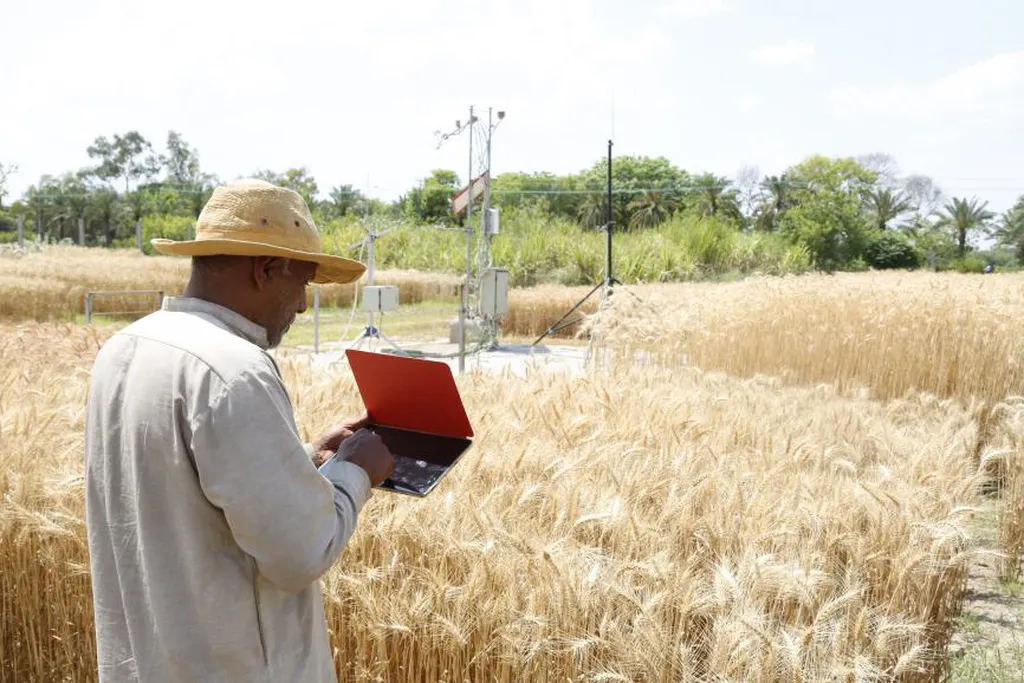
In the heart of Punjab, Pakistan, a groundbreaking study is revolutionizing how farmers monitor and manage their wheat crops. By harnessing the power of remote sensing and machine learning, researchers have developed a precise method to estimate crop age, offering significant benefits for water and nutrient management. This innovative approach, published in the ‘Sir Syed University Research Journal of Engineering and Technology’, could reshape precision agriculture and promote sustainable farming practices.
The study, led by Mutiullah Jamil from the Khwaja Fareed University of Engineering and Information Technology (KFUEIT), utilized Sentinel satellite data to track crop health and growth stages. By employing a range of vegetation indices—such as NDVI, EVI, SAVI, GDVI, and IVI—the research team could accurately assess the age of wheat crops. “The precision of our models is reflected in the strong R² values and low Root Mean Square Error (RMSE) we achieved,” Jamil explained. “This level of accuracy is crucial for making informed decisions about water supply and nutrient management.”
The researchers applied two distinct feature selection approaches: Univariate Linear Regression Tests and the Random Forest Feature Importance method. Polynomial regression models of degrees 1 to 3 were then used to estimate crop age. The results were impressive, with R² values ranging from 0.68 to 0.92 and RMSE values as low as 0.5. These findings highlight the potential of data-driven, remote sensing techniques to enhance precision agriculture.
The commercial impacts of this research are substantial. By providing farmers with timely and accurate information about crop health and age, they can make better decisions about irrigation and fertilization. This not only improves crop yields but also promotes sustainable agricultural practices. “Timely measures can enhance productivity and resilience to environmental stresses,” Jamil noted. “This approach is an important development for agricultural monitoring and management in Punjab and similar agro-ecological areas.”
The study’s findings could shape future developments in the field by emphasizing the importance of strong feature modeling and selection methods. As remote sensing technology continues to advance, the integration of machine learning algorithms will become increasingly vital for precision agriculture. This research paves the way for more efficient and sustainable farming practices, ultimately benefiting both farmers and the environment.
In a world where sustainable agriculture is more critical than ever, this study offers a promising solution. By leveraging the power of remote sensing and machine learning, farmers can make data-driven decisions that enhance productivity and promote environmental resilience. The research led by Mutiullah Jamil from KFUEIT, published in the ‘Sir Syed University Research Journal of Engineering and Technology’, is a testament to the transformative potential of technology in agriculture. As we look to the future, the integration of these innovative techniques will undoubtedly play a pivotal role in shaping the landscape of modern farming.