
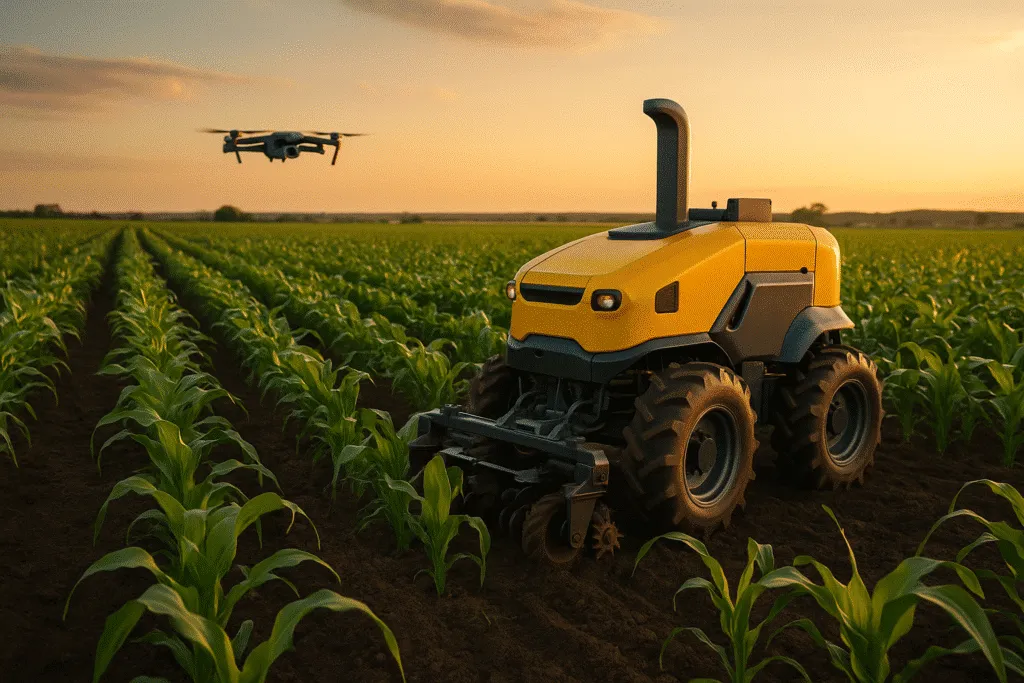
In the heart of Central America and Mexico, maize is more than just a crop—it’s a lifeline. Yet, this vital resource faces an increasingly unpredictable climate, with the El Niño-Southern Oscillation (ENSO) wreaking havoc through drought and erratic rainfall. Enter artificial intelligence (AI) and multispectral imaging technologies, which are stepping up to the plate to help farmers combat these challenges. A comprehensive literature review, led by Carlos R. Martínez-Martínez from the Faculty of Engineering and Natural Sciences at the University of Sonsonate, El Salvador, and published in ‘Maǧallaẗ al-baṣraẗ al-ʻulūm al-zirāʻiyyaẗ’, has shed light on the transformative potential of these technologies for maize production.
The review, which analyzed 111 studies, revealed that AI algorithms and multispectral imaging technologies are becoming indispensable tools for monitoring maize health and predicting yields. “The evidence is clear,” Martínez-Martínez asserts. “These technologies are not just the future; they are the present of precision agriculture.”
One of the standout findings was the repeated success of the Random Forest algorithm. This method has proven particularly adept at image segmentation and the prediction of crop and climate numerical data, often outperforming other methods. But the innovations don’t stop there. Deep learning models like ResNet50 and YOLOv3 have demonstrated an impressive accuracy of over 95% in detecting maize diseases through image recognition. Ensemble approaches, including XGBoost and hybrid models, have also delivered highly accurate yield predictions, with R² values exceeding 0.9.
The commercial implications of these findings are substantial. For the agriculture sector, these technologies promise to revolutionize the way farmers manage their crops. By providing real-time, data-driven insights, they enable more informed decision-making, leading to improved yields and reduced losses. This is particularly crucial in regions where smallholder farms are prevalent, as these technologies can help mitigate the impacts of climate variability and enhance food security.
However, the journey towards widespread adoption is not without its challenges. Martínez-Martínez notes, “While the potential is immense, we must also acknowledge the regional climatic and agricultural constraints that can hinder the application of these technologies in smallholder farms.” Addressing these challenges will require a concerted effort from researchers, policymakers, and industry stakeholders.
Looking ahead, the research highlights the need for local adaptations and further innovation. The integration of AI and multispectral imaging technologies into precision agriculture is still in its nascent stages, but the progress made so far is promising. As these technologies continue to evolve, they hold the key to unlocking new possibilities for sustainable and resilient maize production.
In the words of Martínez-Martínez, “The future of agriculture lies in our ability to harness the power of technology to adapt to and mitigate the impacts of climate change. This review is a step in that direction, but there is still much work to be done.” The journey has begun, and the potential is vast. The question now is, how quickly can the agriculture sector adapt and thrive in this new era of precision agriculture?