
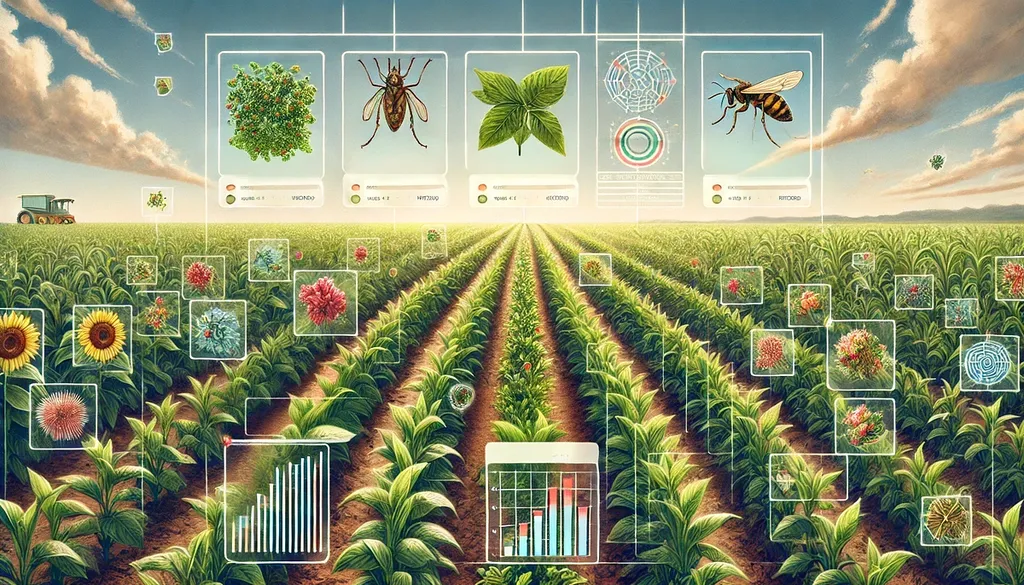
In the face of escalating threats to global food security, a groundbreaking review published in *Maǧallaẗ al-baṣraẗ al-ʻulūm al-zirāʻiyyaẗ* sheds light on how artificial intelligence (AI) is revolutionizing the way farmers detect and manage crop diseases and pests. Led by Hajar Hamdaoui from Mohammed First University in Morocco, the study systematically examines the latest advancements in Convolutional Neural Networks (CNNs), a subset of AI, and their transformative potential for sustainable agriculture.
Crop diseases and pests are a persistent challenge for farmers worldwide, often leading to significant yield losses and economic hardship. Traditional methods of detection, such as manual inspection, are not only labor-intensive but also prone to human error. The study highlights how AI-driven solutions are changing the game. “CNN-based models consistently achieve high detection performance across a wide range of crops and agro-climatic conditions,” Hamdaoui explains. “Many studies report accuracy rates exceeding 95%, which is a game-changer for the agriculture sector.”
The review, which synthesized data from 100 studies published between 2019 and 2025, reveals that AI technologies outperform traditional methods in terms of speed, precision, and scalability. This is particularly relevant in an era where climate change is exacerbating the spread of pests and diseases. By leveraging AI, farmers can make more informed decisions, reduce the use of chemical pesticides, and ultimately improve crop yields.
One of the most exciting findings is the potential for integrating CNN models with IoT (Internet of Things) and edge computing platforms. This integration allows for real-time, field-deployable applications, enabling farmers to detect and manage pests and diseases as soon as they appear. “The combination of AI with IoT and edge computing is a powerful tool for precision agriculture,” says Hamdaoui. “It allows for timely interventions, which can significantly reduce crop losses and improve overall farm productivity.”
However, the study also acknowledges challenges that need to be addressed. Data availability, computational requirements, and deployment in resource-constrained environments are among the key hurdles. Despite these challenges, the potential benefits of AI in agriculture are immense. The study suggests that AI technologies represent a promising pathway toward sustainable crop protection, improved agricultural productivity, and enhanced food security.
The commercial impacts of this research are far-reaching. For the agriculture sector, AI-driven solutions could lead to significant cost savings by reducing the need for manual labor and chemical inputs. It could also open up new markets for tech companies specializing in agricultural AI solutions. As the technology becomes more accessible and affordable, it has the potential to transform farming practices globally, particularly in developing regions where resources are often limited.
Looking ahead, the study’s findings pave the way for future developments in the field. As AI technologies continue to evolve, we can expect to see even more sophisticated solutions for crop protection. The integration of large language models with CNN architectures could further enhance the accuracy and efficiency of pest and disease detection. Additionally, advancements in edge computing and IoT could make these technologies more accessible to small-scale farmers, ensuring that the benefits of AI are widely shared.
In conclusion, the systematic review by Hamdaoui and her team underscores the transformative potential of AI in agriculture. By harnessing the power of CNNs, farmers can detect and manage crop diseases and pests more effectively, leading to improved yields and enhanced food security. As the technology continues to evolve, it is poised to play an increasingly important role in shaping the future of sustainable agriculture.