
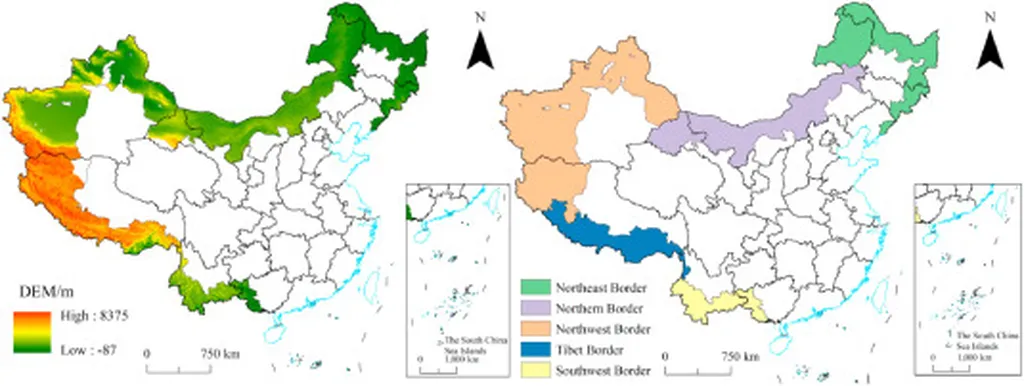
In the vast and ecologically sensitive border regions of China, a delicate balance exists between human activity and environmental preservation. A recent study published in *Resources, Environment and Sustainability* sheds light on the intricate relationship between territorial space use (TSU) and land ecological security (LES), offering a pathway for sustainable development in these critical areas. Led by Guobin Ma from the School of Natural Resources and Surveying and Mapping at Nanning Normal University, the research employs advanced modeling techniques to uncover the threshold effects of TSU on LES, providing valuable insights for policymakers and stakeholders in the agriculture sector.
The study highlights the dual pressures faced by China’s border regions, where ecological fragility and intensive human activity often collide. “The northern border is threatened by ecological degradation in arid regions, while soil erosion affects more than half of the northwest border area, and rocky desertification in the southwest contributes to the desertification of cultivated land and the loss of soil fertility,” explains Ma. These challenges underscore the need for a nuanced approach to spatial governance, one that considers the unique ecological and developmental needs of each region.
Using Boosted Regression Trees (BRT) and Structural Equation Models (SEM), the researchers identified the influence of major TSU types on LES. They found that from 2008 to 2023, the proportion of Other Ecological Space (OE) was the highest at 32.764%, concentrated in the Northern and Northwestern borders. The study also revealed a systematic tendency for the transformation of OE into Water Ecological Space (WE), with spatial transfers dominated by transitions from Agriculture to Urban and Ecology to Urban.
The research further categorized the thresholds for LES, with Agricultural Production Space (AP), Grassland Ecological Space (GE), OE, and Forest Ecological Space (FE) thresholds identified at 0.457, 0.425, 0.330, and 0.345, respectively. These findings are crucial for the agriculture sector, as they highlight the critical levels of land use that must be maintained to ensure ecological security. By understanding these thresholds, farmers and agricultural businesses can make informed decisions about land use, balancing productivity with environmental sustainability.
The study also employed the SOM-K-means clustering method to execute zonal control of the predominant types of TSU. The results showed that in 2023, the grid scale was mainly dominated by WE, FE, and AP, with Key Conservation Areas (KCA) accounting for 38.713%. At the county and city scales, the spatial pattern was formed by Forest Ecological Space Dominant Type (FEL), Agricultural Production Space Dominant Type (APL), Grassland Ecological Space Dominant Type (GEL), and Other Ecological Space Dominant Type (OEL). Remediation and Restoration Areas (RRA) at the county level had the highest percentage at 42.244%, while KCA in city areas accounted for 37.686%.
Based on these findings, the researchers propose a nuanced governance approach termed ‘grid-county-city.’ This approach seeks to offer a foundational theoretical framework and decision-making benchmark for the sustainable utilization of territorial space, as well as for harmonizing security and development in border regions. “Our study provides a comprehensive analysis of the threshold effects of TSU on LES, offering a pathway for integrated governance zoning characterized by ‘Zonal control + hierarchical governance,'” says Ma.
The implications of this research are far-reaching, particularly for the agriculture sector. By understanding the threshold effects of different types of territorial space use on land ecological security, agricultural businesses can adopt more sustainable practices, ensuring long-term productivity while preserving the delicate ecological balance. This research also provides a valuable tool for policymakers, enabling them to make informed decisions about land use and development in China’s border regions.
As the world grapples with the challenges of climate change and environmental degradation, studies like this one are more important than ever. By providing a scientific basis for sustainable land use, this research offers a beacon of hope for the future of agriculture and ecological security in China’s border regions.