
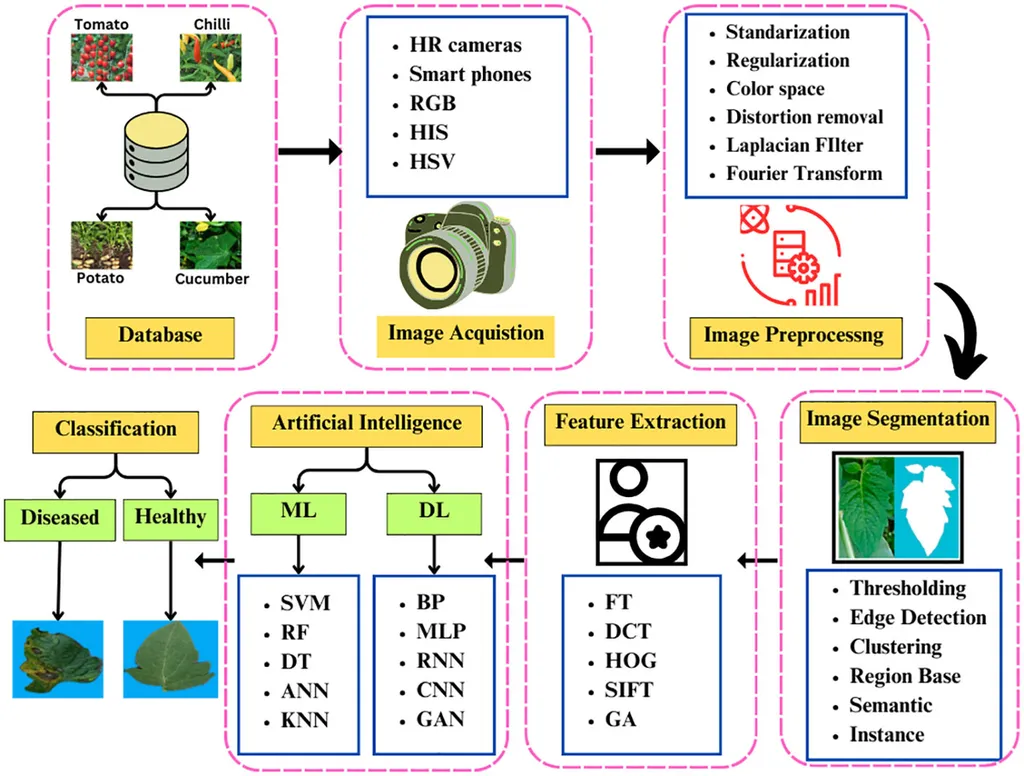
In the ever-evolving landscape of agricultural technology, deep learning has emerged as a powerful tool for managing plant diseases, offering promising solutions to enhance crop yields and ensure food security. A recent study published in the Egyptian Informatics Journal sheds light on the trends, impacts, and intellectual structures of research in this domain, providing valuable insights for the agriculture sector.
The study, led by Freedom M. Khubisa from the MICT SETA 4IR Center of Excellence at the Durban University of Technology in South Africa, conducted a comprehensive bibliometric analysis of 4,317 publications indexed in the Scopus database from 2016 to 2025. The research focused on plant disease management utilizing deep learning methods, evaluating contributions, impacts, and trends through various metrics.
“Deep learning offers alternative methods to proactively manage plant diseases, ensuring healthy crop yields and minimizing economic losses,” Khubisa explained. The analysis revealed that Computers and Electronics in Agriculture and IEEE Access are the most impactful publication sources, with a publication by Mohanty SP in 2016 being the most globally cited.
The study identified five distinctive clusters through bibliographic coupling of publications and co-word analysis of author keywords, providing useful insights into the knowledge structure of plant disease management using deep learning. These findings can guide future research directions and advance artificial intelligence applications in agriculture.
The commercial impacts of this research are significant. By leveraging deep learning, farmers and agribusinesses can detect and manage plant diseases more effectively, reducing crop losses and improving overall productivity. This technology can also contribute to sustainable agricultural practices, addressing global food security challenges.
As the agriculture sector continues to embrace digital transformation, the insights from this bibliometric analysis can shape future developments in plant disease management. The study highlights the importance of collaborative research and the need for continued innovation in applying deep learning to agricultural challenges.
In the words of Khubisa, “This analysis offers a footing for progressing artificial intelligence applications in plant disease management, guiding future research directions.” The findings not only provide a roadmap for researchers but also offer practical benefits for the agriculture sector, paving the way for more resilient and productive farming practices.