
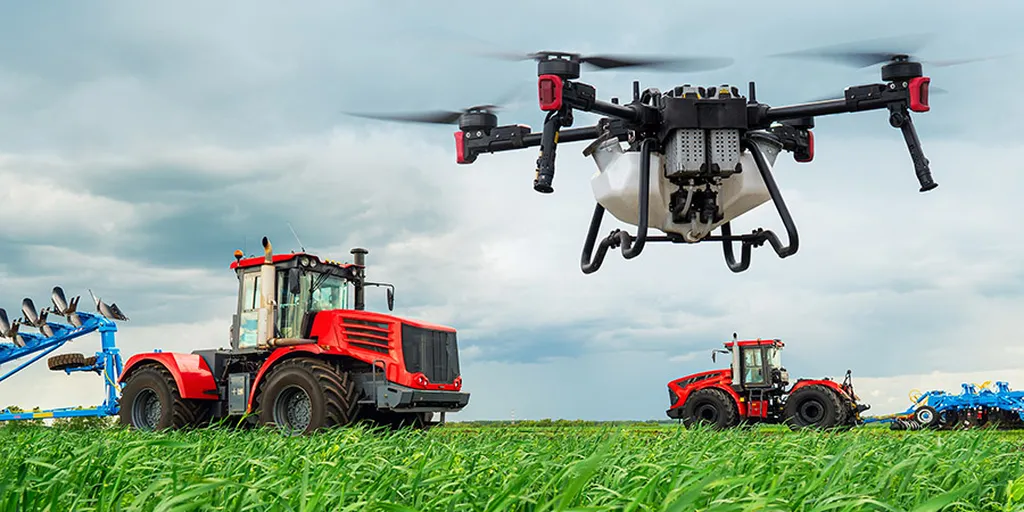
Drones are increasingly becoming an essential labour-offset tool for Australian growers, enabling large farms to operate efficiently with fewer onsite workers. The most significant impact is observed when drone data is integrated with software, AI, and automated workflows, rather than using drones solely for visual monitoring. Key high-value use cases include precision spraying, livestock monitoring, vineyard heat-stress mapping, and broadacre yield forecasting, all of which deliver measurable results. The return on investment (ROI) is strongest when farms measure cost per hectare per decision, rather than focusing on the upfront cost of hardware. Long-term advantages come from building custom digital platforms, giving growers ownership of data, integrations, workflows, and scalability.
Across Australia, many growers manage farms that span hundreds of hectares but face a shrinking workforce. According to the Australian Bureau of Agricultural and Resource Economics and Sciences (ABARES), the agricultural sector employs about 255,500 people in 2025, less than 2% of the national workforce, and this proportion continues to decline compared to the scale of agricultural land under management. This gap between staffing needs and available labour has pushed technology, particularly drones, into a more central role in Australian agriculture.
Many farms are beginning to use drones to reduce the hours required for inspecting paddocks, assessing crop health, or monitoring livestock. For growers managing vast distances and narrow seasonal windows, agricultural drones have become a practical way to keep operations moving when labour is scarce. This shift is less about technology replacing people and more about growers needing tools to remain competitive with the workforce they have. Drones are becoming part of that operational toolkit.
Australia’s precision agriculture market is set to grow at a 9.1% compound annual growth rate (CAGR) through 2033, creating a window for early adopters to gain the most value. The strategic use cases for drones in Australian agriculture are where technology changes outcomes on the ground. In Australia, where distances are long and climate pressures are intense, the strongest use cases sit at the intersection of time, labour, and seasonal timing.
One of the key reasons drones are gaining traction in Australian agriculture is their ability to treat only the land that needs attention, rather than applying chemicals blanket-wide. For large cotton, rice, and broadacre grain farms, this creates cost savings and environmental benefits. Chemical prices have increased significantly over the past 24 months, making input costs a top three pressure on growers, according to the AgriFutures National Producer Survey 2024. Drones enable auto-generated spray zones based on vegetation index maps, precision droplet sizing that reduces drift, and the treatment of isolated weeds without damaging adjacent healthy crops. According to FarmTable, targeted drone application and precision spraying approaches can reduce chemical use by up to 30% by treating only the land that requires attention, directly cutting operational costs and limiting unnecessary inputs.
Australia’s livestock operations face a scale challenge, with cattle stations in the Northern Territory and Queensland often spanning thousands of hectares. A single herd check can take hours of travel. Drones change this equation by flying pre-planned livestock count routes in minutes, using thermal signatures to detect sick or isolated cattle quickly, and providing muster direction guidance that reduces motorbike and vehicle usage. SkyKelpie, an Australian agtech startup, is pioneering drone-assisted mustering by integrating modern technology to predict herd movement patterns. This use case offers labour offsets with safety dividends, reducing hours spent on-ground in dangerous terrain and lowering fuel, quad-bike, and maintenance costs.
In vineyards and orchards, small timing errors can compound into millions in loss. Grapes, citrus, apples, and stone fruit require visibility at the exact moment stress hits. Drones make it possible to model canopies using LiDAR to optimise pruning timing, detect heat stress before visible wilting, and estimate fruit load to support logistics and price setting. Research shows that UAV-borne multispectral and thermal imagery can detect plant stress indicators for irrigation and water management before physical changes are obvious, improving precision vineyard management.
For broadacre producers managing wheat, barley, oats, canola, and cotton, yield visibility often comes too late. Drones offer earlier insight by using AI for demand forecasting. They enable NDVI-based stress mapping, zone-specific fertiliser placement, and prediction of harvest tonnage weeks earlier, as well as crop emergence validation after planting. The Australian agriculture drones market is growing rapidly, with AI-powered data analytics enabling real-time monitoring of crop health, optimising irrigation and pest management, and helping farmers make informed decisions to improve yields.
Australian agriculture is shifting toward data-driven operating models, supported by sensing technology, analytics, and integrated systems. CSIRO outlines this shift as a move toward a coordinated system involving sensing, data management, analytics, modeling, and