
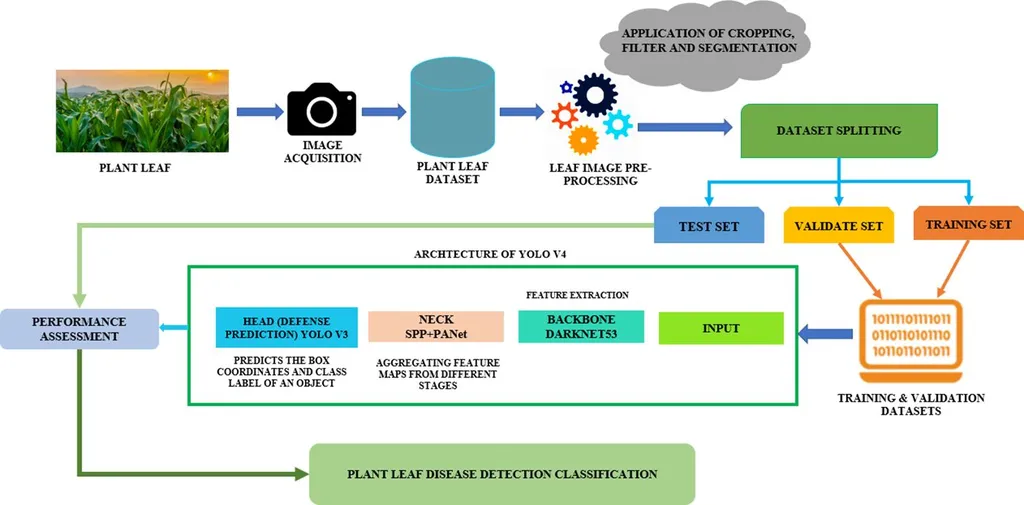
In the relentless battle against plant diseases, which threaten global food security and agricultural productivity, a new wave of technological innovation is emerging. Researchers are increasingly turning to machine learning (ML) and deep learning (DL) models to detect plant diseases with unprecedented accuracy, potentially revolutionizing how farmers and agronomists manage crop health. A recent study published in the *Journal of Information Systems and Informatics* offers a comprehensive review of these advancements, shedding light on the most effective techniques and the challenges that lie ahead.
The study, led by Alfred Thaga Kgopa of the University of South Africa, systematically analyzed 625 peer-reviewed articles published between 2017 and 2025, evaluating the performance of various ML and DL models in plant disease detection. The findings reveal that models such as YOLOv4, VGG19, ResNet50, and MobileNetV2 have achieved remarkable accuracy levels, ranging from 98% to 99.99%. These models were primarily trained on the PlantVillage dataset or custom-annotated datasets, demonstrating their potential to transform disease detection in agriculture.
One of the most compelling aspects of this research is its focus on real-world applicability. Several studies highlighted in the review have successfully deployed these models in real-time applications, using mobile and edge devices. This capability is crucial for farmers, who often need immediate insights to take timely action against diseases. “The ability to detect diseases early and accurately can significantly reduce crop losses and improve yield,” Kgopa noted, emphasizing the commercial impact of these technologies.
However, the study also identifies several challenges that must be addressed before these models can be widely adopted. Limited dataset diversity and poor model generalization across different environments are significant hurdles. Additionally, models often perform less effectively under real-field conditions compared to controlled laboratory settings. These issues underscore the need for more robust, adaptable, and field-ready models that can handle the complexities of real-world agriculture.
The commercial implications of this research are profound. As the global population continues to grow, the demand for food will increase, making it essential to maximize agricultural productivity. AI-driven disease detection can play a pivotal role in this effort by enabling early intervention and reducing the need for chemical treatments, which can be costly and environmentally harmful. Moreover, the integration of these technologies into existing agricultural practices could lead to more sustainable and efficient farming methods.
Looking ahead, the study suggests that future developments in AI-based plant disease detection should focus on creating lightweight, adaptable models that can be easily deployed in various agricultural settings. This will require collaboration between researchers, technologists, and farmers to ensure that the models are not only accurate but also practical and accessible.
As the agricultural sector continues to evolve, the role of AI in plant disease detection will undoubtedly become more prominent. The insights provided by this study offer a roadmap for future research and development, highlighting the potential of ML and DL models to shape the future of agriculture. With continued innovation and collaboration, these technologies could help secure global food supplies and support the livelihoods of farmers worldwide.