
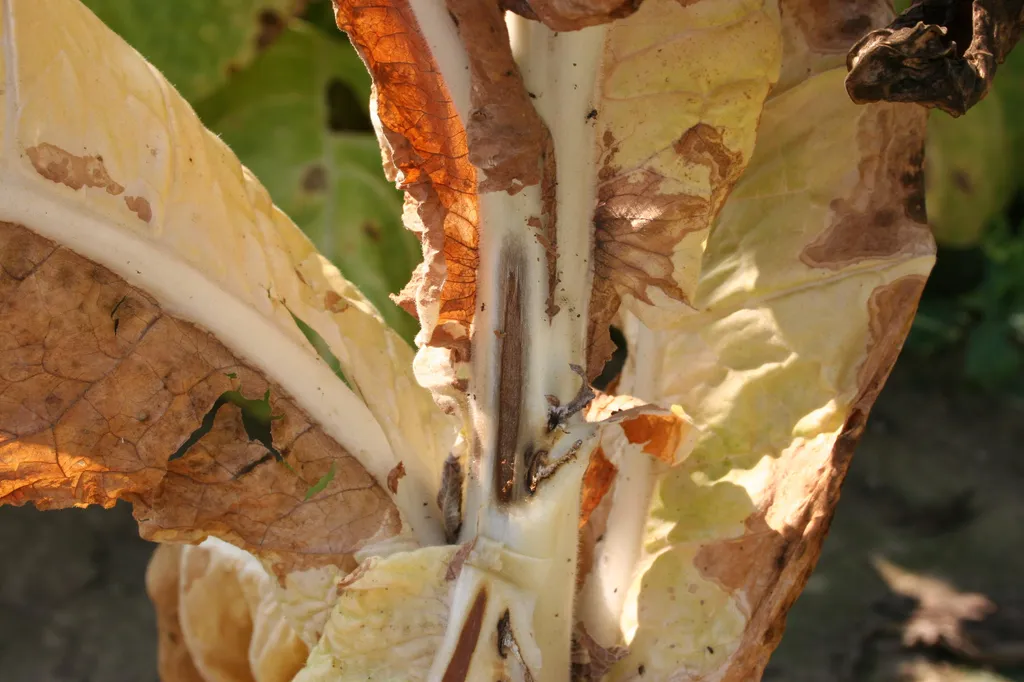
In the heart of China’s Sichuan Province, a quiet revolution is taking place in the fields of tobacco cultivation. Researchers have uncovered a promising new strategy to combat Fusarium wilt, a devastating disease that threatens global tobacco production. The key to this breakthrough lies in the intricate world of the plant microbiome, where beneficial fungi like Aspergillus may hold the power to suppress pathogens and safeguard crops.
The study, published in the journal *Environmental Microbiome*, was led by Shuang Han of the Sanya Institute of Nanjing Agricultural University. The research team investigated the root-associated fungal communities in both healthy and Fusarium-infected tobacco plants across three distinct fields. Their findings revealed a stark contrast in the fungal community compositions between healthy and diseased plants.
“Healthy tobacco plants assemble distinct root-associated fungal communities, enriched with beneficial taxa like Aspergillus,” Han explained. “These beneficial fungi could be crucial for disease suppression, offering a sustainable solution to the pressing issue of Fusarium wilt.”
The researchers identified Aspergillus OTU2223 as a dominant and potentially crucial taxon in healthy rhizospheres. In contrast, diseased soils were dominated by pathogenic Fusarium taxa, with Fusarium solani being the most prevalent. The study also found that healthy rhizospheres maintained a more complex and interconnected microbial network, suggesting a stronger resilience against pathogens.
One of the most promising findings was the isolation and characterization of Aspergillus strain A74, which demonstrated strong antagonistic activity against F. solani f. sp. nicotianae. In greenhouse trials, the application of strain A74 significantly reduced the incidence of Fusarium wilt disease and maintained the growth parameters of pathogen-inoculated plants at levels comparable to healthy plants.
The commercial implications of this research are substantial. Fusarium wilt is a significant threat to tobacco production, causing yield losses and requiring costly management strategies. The use of beneficial Aspergillus strains as biocontrol agents could offer an environmentally friendly and sustainable approach to disease management, reducing the reliance on chemical fungicides and improving the economic viability of tobacco farming.
“This research provides a theoretical foundation and practical support for the development of Aspergillus-based green biocontrol strategies,” Han noted. “It highlights the potential of these beneficial fungi as a sustainable approach to disease management in tobacco production and beyond.”
The findings could also extend beyond tobacco, offering insights into the management of Fusarium wilt in other crops. The study underscores the importance of understanding and harnessing the power of the plant microbiome, a field that is rapidly gaining traction in the agricultural sector.
As the world seeks sustainable solutions to feed a growing population, the exploration of beneficial plant-microbe interactions offers a promising avenue for innovation. This research not only sheds light on the complex dynamics of the tobacco rhizosphere but also paves the way for future developments in biocontrol strategies, shaping the future of agriculture in an increasingly challenging climate.
In the quest for sustainable and environmentally friendly agricultural practices, the humble Aspergillus fungus may well emerge as a hero, offering a natural and effective solution to one of the industry’s most pressing challenges.