
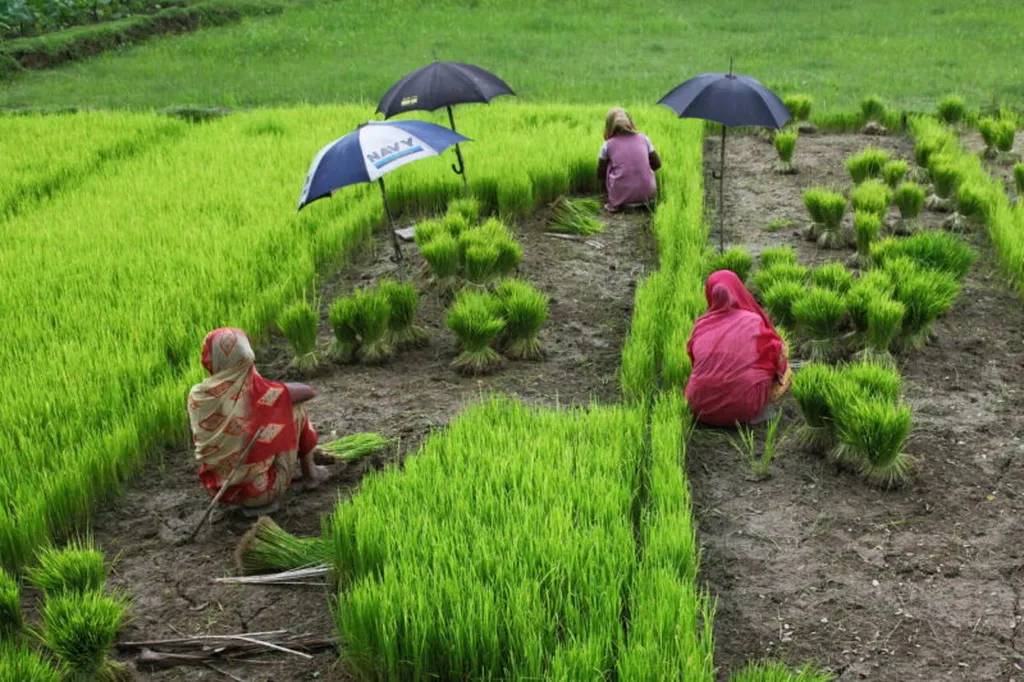
In the heart of Bangladesh, where the lifeblood of the nation’s food security flows through the verdant rice paddies, a silent threat is looming. Climate change, with its insidious creep of rising temperatures, is casting a long shadow over the country’s agricultural future. A recent study published in *Scientific Reports* has shed light on the spatiotemporal trends of temperature variability during the critical T. Aman rice-growing season, offering a stark warning and a glimmer of hope for the agriculture sector.
The research, led by Niaz Md. Farhat Rahman from the Agromet Lab at the Bangladesh Rice Research Institute (BRRI), delves into temperature trends from 1961 to 2023, using data from the Bangladesh Meteorological Department (BMD). The study focuses on three climatic regions: Barind, Coastal, and Haor, each with its unique ecological and agricultural characteristics.
The findings are alarming. The Mann–Kendall test revealed statistically significant warming trends in both maximum and minimum temperatures, with the Haor region experiencing the most pronounced increase. “The Haor region is particularly vulnerable,” Rahman explains, “as it is already prone to flooding and waterlogging. Rising temperatures exacerbate these conditions, threatening the very foundation of rice production in these areas.”
The study also employed Moran’s I spatial statistics to detect spatial clustering of high-risk zones. The results showed that Barind districts are facing severe maximum temperature risks, with temperatures soaring above 40°C, while Sylhet is grappling with heightened minimum temperature risks. These spatial patterns underscore the need for region-specific climate adaptation strategies.
One of the most promising aspects of the study is the application of machine learning models to predict temperature variability. The Multi-Layer Perceptron (MLP) model, in particular, outperformed other models like SVM, CNN, LSTM, ANN, RF, and Ensemble, achieving the lowest errors across all ecosystems. “The MLP model’s superior performance is a significant breakthrough,” Rahman notes. “It provides a robust tool for predicting temperature variability, which is crucial for developing effective climate adaptation strategies.”
The commercial impacts of this research on the agriculture sector are profound. Rice is the staple food of Bangladesh, and any threat to its production has far-reaching consequences for food security and the livelihoods of millions of farmers. The study’s findings highlight the urgent need for region-specific climate adaptation strategies to mitigate the risks posed by rising temperatures.
Moreover, the application of machine learning models offers a powerful tool for predicting temperature variability, enabling farmers and policymakers to make informed decisions. “This research provides a multidimensional framework that is rarely applied in Bangladesh,” Rahman states. “It offers a comprehensive approach to understanding and addressing the challenges posed by climate change.”
As we look to the future, this research is set to shape the development of climate-resilient agriculture in Bangladesh. By understanding the spatiotemporal trends of temperature variability and leveraging the power of machine learning, we can pave the way for a more sustainable and secure agricultural future. The study’s findings serve as a clarion call for action, urging stakeholders to prioritize climate adaptation and invest in innovative technologies to safeguard the nation’s food security.
In the words of Rahman, “The time to act is now. We must harness the power of science and technology to build a resilient agriculture sector that can withstand the challenges of a changing climate.” This research is a significant step in that direction, offering hope and a roadmap for a sustainable future.