
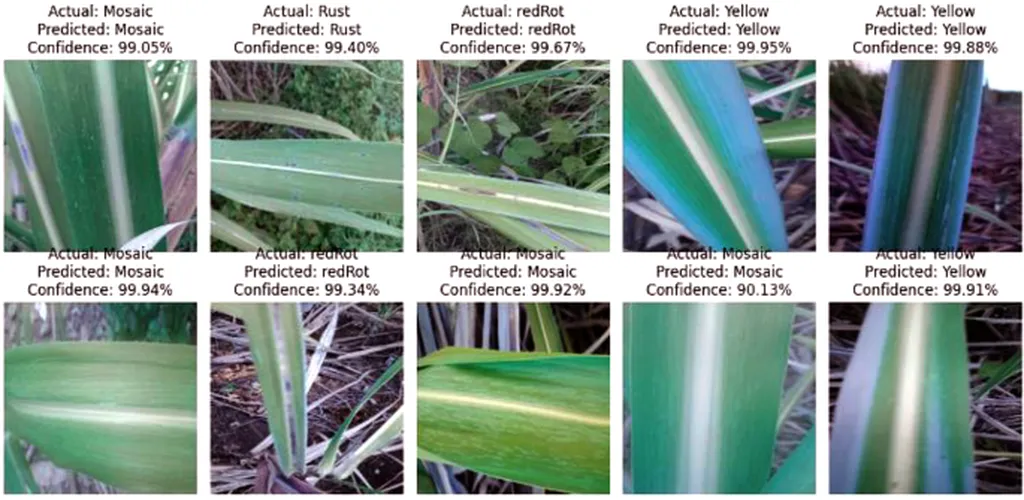
In the heart of Bangladesh, a groundbreaking approach to sugarcane disease detection is taking root, promising to revolutionize precision agriculture and bolster the agricultural sector’s resilience. Researchers have developed a novel deep learning model that could significantly enhance early disease detection in sugarcane crops, potentially saving farmers millions in losses and promoting sustainable farming practices.
The Multi-scale Attention-based Dense Residual Network (MADRN), designed by lead author Jannatul Mauya and her team at the Deep Statistical Learning and Research Lab, Department of Statistics, Pabna University of Science and Technology, is a sophisticated model that integrates dense residual learning and multi-scale attention mechanisms. This combination allows the model to capture fine-grained, disease-specific features, addressing the challenges of domain variability and complex data patterns that often plague traditional detection methods.
“Early and accurate detection of sugarcane leaf diseases is critical for improving crop productivity and reducing economic losses,” Mauya explained. “Our model, MADRN, has shown remarkable promise in this area, outperforming baseline models in accuracy, precision, recall, and F1-score across diverse datasets.”
The MADRN model was evaluated using two datasets: a Kaggle dataset and a blended dataset that combined Kaggle images with those from the Bangladesh Sugarcrop Research Institute (BSRI). This blending approach simulated real-world conditions, making the results more applicable to practical agricultural scenarios. The model achieved an impressive accuracy of 94.78% on the Kaggle dataset and 92.25% on the blended dataset, demonstrating its superior ability to learn discriminative features and generalize effectively across different data sources.
The commercial impacts of this research are substantial. Sugarcane is a vital cash crop in many regions, and diseases can lead to significant yield losses. Early detection allows for timely interventions, enabling farmers to manage resources more effectively and implement targeted treatments. This not only improves crop productivity but also reduces the environmental impact of agriculture by minimizing the use of pesticides and other chemicals.
“Our findings highlight MADRN’s potential as a tool for precision agriculture and disease management,” Mauya noted. “The development of a web-based application for real-time and user-friendly disease detection further facilitates practical implementation, making advanced technology accessible to farmers.”
The research, published in Scientific Reports, lays a strong foundation for the development of accurate, scalable, and practical disease classification tools. As the agricultural sector continues to embrace technology, innovations like MADRN could become integral to sustainable farming practices. Future developments in this field may see the integration of such models with other agricultural technologies, such as drones and IoT devices, creating a comprehensive ecosystem for crop monitoring and management.
In the broader context, this research underscores the importance of interdisciplinary collaboration in addressing agricultural challenges. By leveraging advancements in deep learning and image processing, researchers are paving the way for more resilient and productive farming practices. As the world grapples with the impacts of climate change and growing food demands, such innovations are more critical than ever.
The journey towards sustainable agriculture is fraught with challenges, but with tools like MADRN, farmers and researchers are better equipped to navigate the path ahead. The future of agriculture is not just about growing crops; it’s about growing smarter, and this research is a significant step in that direction.