
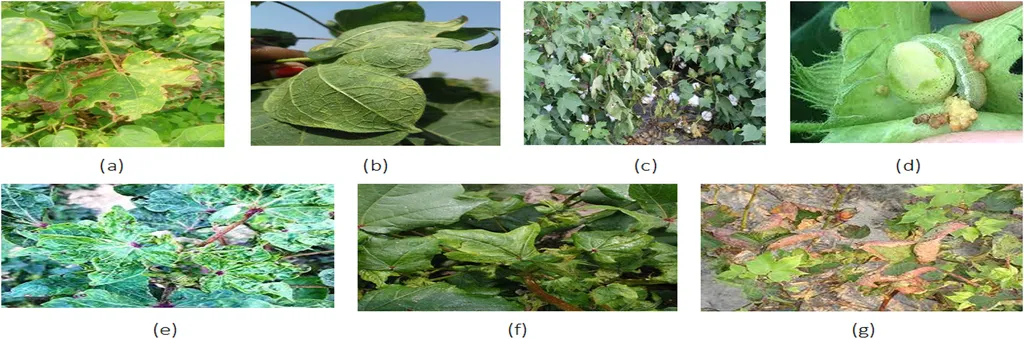
In the heart of India’s agricultural landscape, a technological revolution is brewing, one that could redefine how farmers combat one of cotton’s most insidious foes: leaf disease. A novel deep learning framework, dubbed CLD-Net, is poised to transform cotton leaf disease detection, offering a potent blend of speed and accuracy that could bolster yields and fortify the agricultural sector.
The brainchild of S. Chinnadurai from the Department of Computer Science and Engineering at Dhanalakshmi Srinivasan University, CLD-Net marries two state-of-the-art object detection algorithms—YOLOv5 and Faster R-CNN—to deliver real-time, precise disease identification. This fusion capitalizes on YOLOv5’s swift detection capabilities and Faster R-CNN’s meticulous classification, creating a robust system tailored to the vagaries of environmental conditions.
“CLD-Net is not just about detecting diseases; it’s about empowering farmers with timely, actionable insights,” Chinnadurai asserts. The framework’s prowess lies in its ability to identify diseases in their nascent stages, a critical factor in mitigating yield loss. With an impressive accuracy rate of 96.7%, CLD-Net outperforms traditional models, offering a scalable, real-time solution that could reshape smart agriculture.
The implications for the agricultural sector are profound. By enabling early disease detection, CLD-Net can help farmers implement targeted interventions, reducing crop loss and enhancing productivity. Moreover, its real-time capabilities make it an ideal tool for agronomists and sensor deployment, facilitating proactive disease management strategies.
The research, published in *Scientific Reports*, underscores the potential of deep learning in revolutionizing crop disease detection. As Chinnadurai notes, “The integration of advanced algorithms into agricultural practices is not just a possibility; it’s the future.” This future could see farmers leveraging AI-driven tools to monitor crop health, optimize resource use, and ultimately, secure food security.
CLD-Net’s success could spur further innovations in the field, with researchers exploring similar frameworks for other cash crops. The fusion of deep learning and agriculture holds immense promise, offering a glimpse into a future where technology and agronomy intertwine to create resilient, productive farming ecosystems. As the agricultural sector grapples with the challenges of climate change and resource scarcity, tools like CLD-Net could prove indispensable, heralding a new era of smart, sustainable farming.