
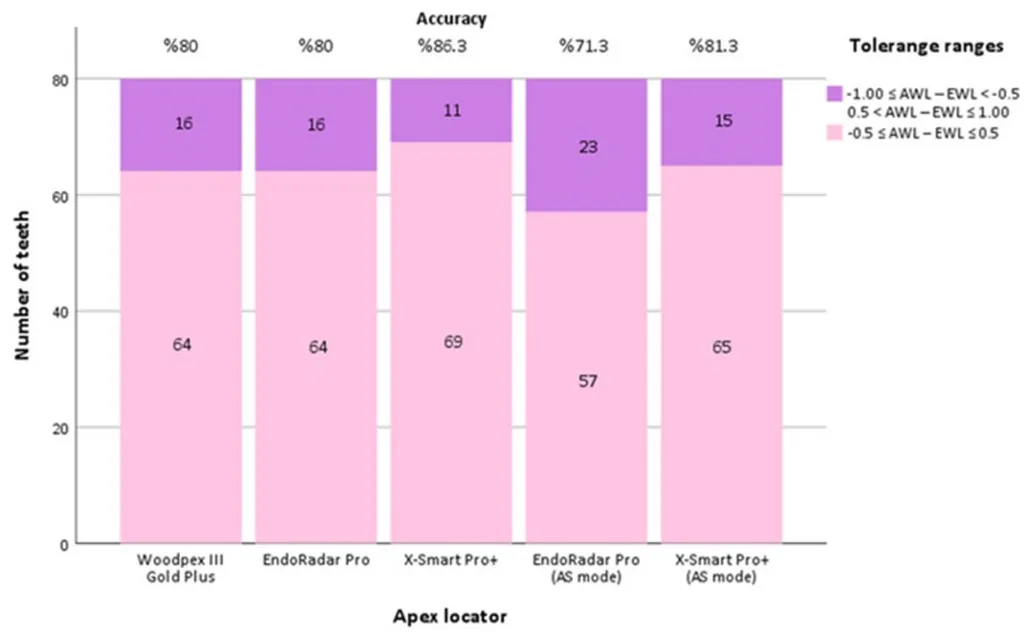
In the ever-evolving landscape of endodontic technology, a recent study published in *Scientific Reports* has shed light on the intricate dance between irrigation solutions and the accuracy of apex locators, tools crucial for determining the working length during root canal treatments. The research, led by Güliz Rana Tellioğlu Avcı from the Department of Endodontics at Batman University, explores how different irrigation solutions can influence the precision of these devices, potentially reshaping clinical practices and commercial strategies in the dental industry.
Apex locators are indispensable tools in modern endodontics, providing electronic measurements to determine the working length of root canals. However, the accuracy of these devices can be influenced by various factors, including the type of irrigation solution used during the procedure. The study aimed to evaluate the effect of four common irrigation solutions—sodium hypochlorite (NaOCl), ethylenediaminetetraacetic acid (EDTA), Dual Rinse HEDP (DR-HEDP), and Triton—on the accuracy of three apex locators: Woodpex III Gold Plus, EndoRadar Pro, and X-Smart Pro+. The research also examined the performance of two integrated motors, EndoRadar Pro and X-Smart Pro+, using a glide path file with the ‘auto-stop (AS)’ mode.
The study involved 240 Vertucci type 1 teeth, with 80 teeth allocated for hand file measurements and 160 teeth for AS mode measurements. The teeth were divided into groups based on the irrigation solution used, and the electronic working length (EWL) was measured sequentially for each device. The actual working length (AWL) was determined, and the differences between AWL and EWL were evaluated within a ±0.5 mm tolerance.
The results revealed that the main effects of the solution and apex locator were not significant, indicating that the choice of irrigation solution and apex locator did not significantly impact the accuracy of measurements. However, the study found that the risk of measurement values falling outside the ±0.5 mm range was 2.158 times higher in the NaOCl group compared to the Triton group. Additionally, Triton and DR-HEDP allowed for measurements to be within the ±0.5 mm range in a greater number of samples, suggesting that these solutions may offer more consistent results.
“Our findings highlight the importance of considering the type of irrigation solution used during root canal treatments,” said Güliz Rana Tellioğlu Avcı. “While the choice of apex locator and irrigation solution did not significantly affect the overall accuracy, certain solutions like Triton and DR-HEDP showed a tendency for more consistent measurements within the desired tolerance range.”
The implications of this research extend beyond the clinical setting, with potential commercial impacts for the agriculture sector. As the demand for precision in dental treatments continues to grow, manufacturers of irrigation solutions and apex locators may need to adapt their products to ensure compatibility and accuracy across different clinical scenarios. The study’s findings could influence the development of new irrigation solutions and apex locators, as well as the marketing strategies of companies in the dental industry.
Moreover, the research underscores the need for further studies to explore the interactions between irrigation solutions and apex locators, as well as the potential benefits of integrating these technologies into clinical practice. As the field of endodontics continues to evolve, the pursuit of accuracy and consistency in root canal treatments remains a top priority, and this study represents a significant step forward in that endeavor.
In the quest for precision in endodontic treatments, the interplay between irrigation solutions and apex locators has emerged as a critical factor. The research led by Güliz Rana Tellioğlu Avcı from the Department of Endodontics at Batman University, published in *Scientific Reports*, offers valuable insights into this complex relationship, paving the way for future developments in the field. As the dental industry continues to innovate, the findings of this study will undoubtedly shape the commercial landscape and clinical practices, ensuring that patients receive the highest standard of care.