
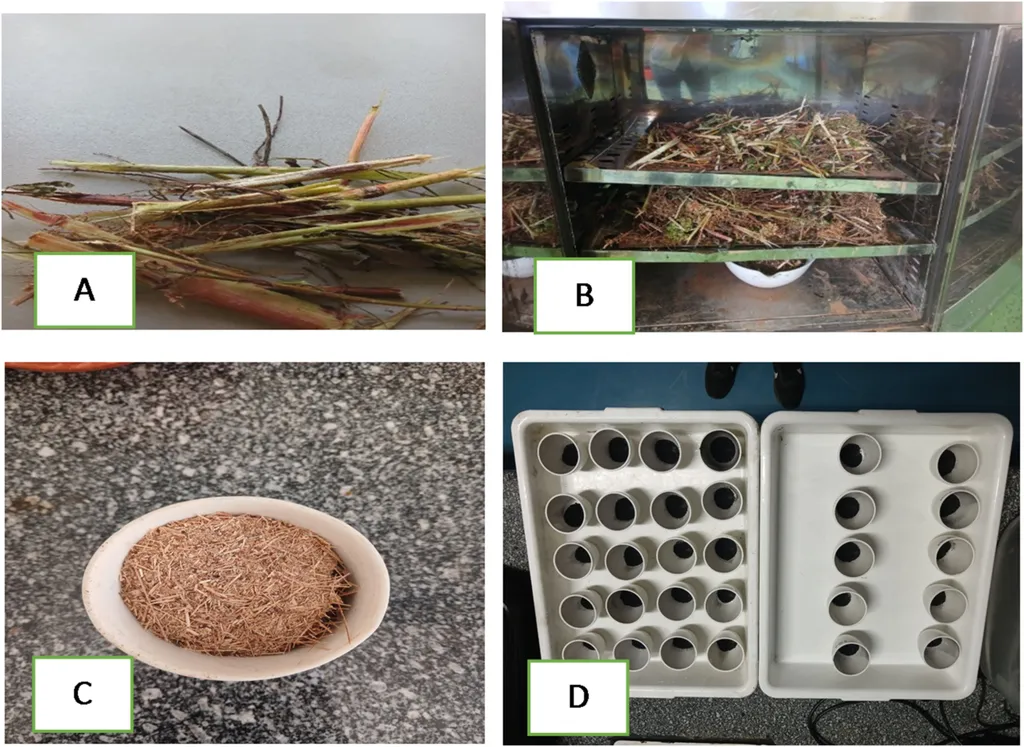
In the heart of Ethiopia’s highlands, where soil degradation threatens agricultural productivity, a promising solution emerges from an unlikely source: the stems of Rumex abyssinicus, a plant deeply rooted in the region’s culture. Researchers have optimized the production of biochar from this abundant plant, offering a beacon of hope for restoring degraded soils and boosting crop yields.
Biochar, a carbon-rich product derived from the pyrolysis of organic materials, has long been recognized for its potential to enhance soil health. However, its effectiveness is heavily dependent on the feedstock and production conditions. A recent study published in *Scientific Reports* addresses this challenge by optimizing the production of biochar from Rumex abyssinicus stems, a resource that has previously been overlooked.
Led by Solomon Tibebu from the Department of Environmental Engineering at Addis Ababa Science and Technology University, the research team employed response surface methodology (RSM) to fine-tune the pyrolysis parameters. By optimizing temperature, time, heating rate, and particle size, they achieved a remarkable biochar yield of 31.98% under ideal conditions.
The resulting biochar boasts impressive properties, including high fixed carbon content (78.8%), a large surface area (455.1 m²/g), and favorable characteristics such as pHpzc (9.2), water holding capacity (5.56 g/g), and cation exchange capacity (15 meq/100 g). These attributes make it an excellent candidate for soil amendment.
To test its efficacy, the researchers conducted a 100-day pot experiment using soil from Wolayta, a region grappling with soil degradation. The results were striking. The biochar treatment led to significant improvements in soil bulk density (−49.24%), porosity (+81.47%), pH (+24.57%), and organic matter content (+531.33%). Statistical analysis confirmed the treatment’s positive effects across these key parameters.
“This study demonstrates that Rumex abyssinicus biochar is a viable, locally sourced amendment for degraded soils,” said Tibebu. “Its use is recommended for sustainable land restoration and climate-resilient agriculture in Ethiopia.”
The commercial implications for the agriculture sector are substantial. By leveraging a locally abundant and culturally significant plant, farmers can access a cost-effective and sustainable solution for soil restoration. This not only enhances agricultural productivity but also contributes to climate-resilient farming practices, which are crucial in the face of increasing environmental challenges.
The research also opens doors for future developments in the field. As Tibebu notes, “The optimization of biochar production from Rumex abyssinicus sets a precedent for exploring other underutilized plant species as potential feedstocks for biochar production.” This could lead to a diverse range of biochar products tailored to specific soil and climatic conditions, further advancing the field of soil restoration.
In conclusion, this groundbreaking research highlights the potential of Rumex abyssinicus biochar as a game-changer for soil restoration in Ethiopia. By optimizing production processes and demonstrating significant improvements in soil health, the study paves the way for sustainable and resilient agricultural practices. As the world grapples with the challenges of soil degradation and climate change, such innovations offer a glimmer of hope for a more sustainable future.