
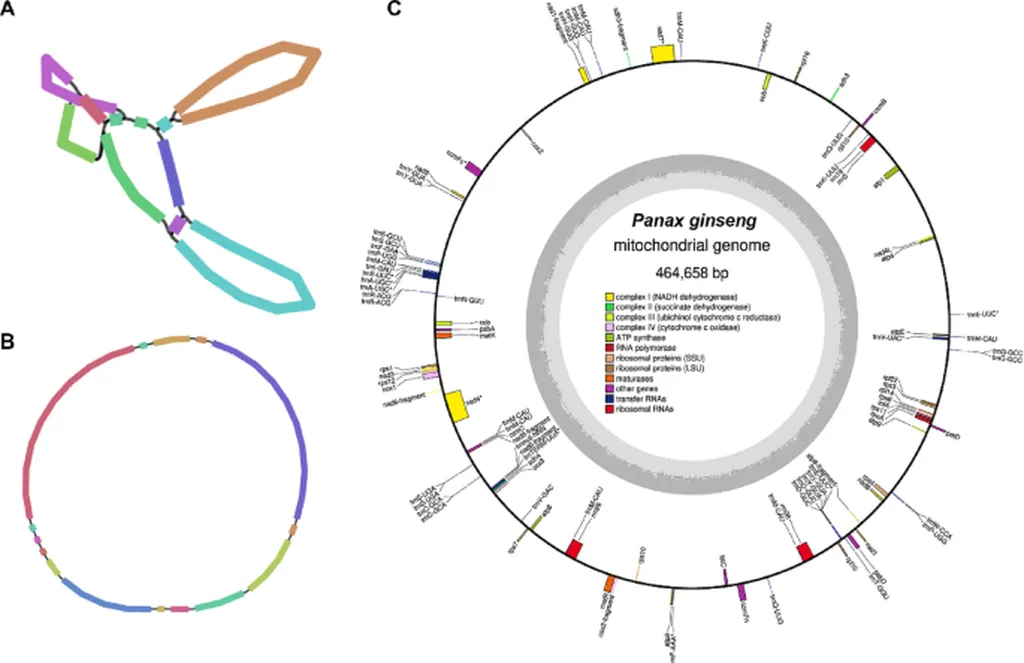
In the world of medicinal plants, ginseng stands as a towering figure, revered for its medicinal properties and significant economic value. However, the preservation of its genetic stability and targeted selection has posed substantial challenges. A recent study published in *Scientific Reports* sheds light on the mitochondrial genome of Panax ginseng, offering insights that could revolutionize the conservation and breeding of this valuable plant.
The research, led by Yidan Xi from the College of Pharmacy at Liaoning University of Traditional Chinese Medicine, employed advanced sequencing technologies to assemble the complete mitochondrial genome of the BT cultivar of Panax ginseng. The genome, spanning approximately 465 kilobases with a 55% A+T content, encodes 80 functional genes. This comprehensive analysis provides a foundational understanding of the structural characteristics and evolutionary patterns of the ginseng mitochondrial genome.
One of the key findings of the study is the identification of repetitive sequences and codon usage patterns, with a notable preference for G/C at the third codon positions. “These patterns are crucial for understanding the genetic diversity and stability of ginseng,” explains Xi. The study also revealed that while most genes underwent purifying selection, respiratory chain genes such as nad4 and cox2 exhibited positive selection signals, indicating their adaptive evolution.
Phylogenetic analysis confirmed the close relationships between ginseng and P. quinquefolius, with P. notoginseng forming a distinct clade. This information is vital for the classification and conservation of ginseng species. The researchers constructed a mitochondrial genome variation map by integrating data from six ginseng populations, revealing high genetic stability across populations. Despite this stability, SNPs, InDels, and structural variations were identified, providing valuable markers for future genetic studies.
The implications of this research for the agriculture sector are profound. By elucidating the structural features and evolutionary dynamics of the P. ginseng mitochondrial genome, the study offers key genetic resources and molecular markers for high-resolution phylogenetic analysis of the Araliaceae family. This knowledge is instrumental for functional research on mitochondrial genomes of medicinal plants and targeted breeding of P. ginseng varieties.
“Our findings not only clarify the genetic landscape of ginseng but also pave the way for the sustainable utilization of its germplasm resources,” says Xi. The study’s insights could accelerate molecular selection processes, enhancing the efficiency and effectiveness of ginseng cultivation and conservation efforts.
As the agricultural sector continues to evolve, the integration of advanced genomic technologies will play a pivotal role in shaping the future of crop improvement. This research underscores the importance of genetic diversity and stability in the conservation and breeding of medicinal plants, offering a blueprint for similar studies in other plant species.
In the words of Yidan Xi, “Understanding the genetic underpinnings of ginseng is the first step towards unlocking its full potential for medicinal and economic benefits.” With this study, the agricultural community is one step closer to achieving that goal, heralding a new era of innovation and sustainability in the cultivation of this revered plant.