
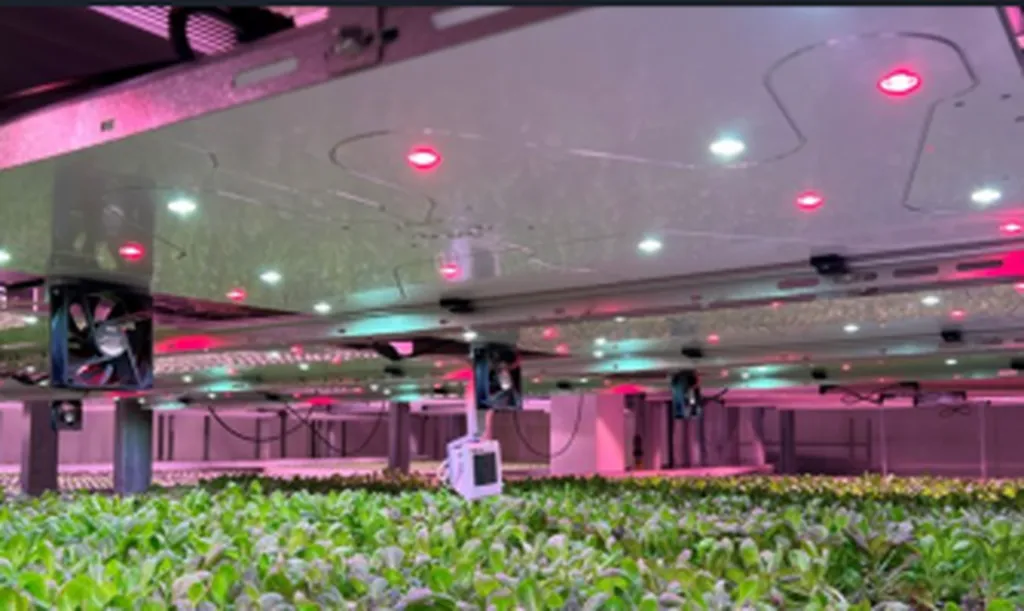
In the quest to optimize plant growth in controlled environments, a recent study published in *Scientific Reports* has shed light on the nuanced effects of LED lighting on vegetative propagation. Led by Jae-Hoon Park from the Biotechnology Research Institute at Kongju National University, the research focused on Dysophylla yatabeana, an aquatic species notoriously difficult to propagate via seeds. The findings could have significant implications for the agriculture sector, particularly in the realm of closed-type smart farms.
The study explored how different combinations of red (R), blue (B), and white (W) LED light influence key physiological indicators such as net photosynthetic rate, transpiration rate, and leaf temperature. By cultivating plants under five distinct spectral treatments and a natural light control, the researchers uncovered that the addition of white light significantly boosted both shoot dry weight and the number of rhizomes. This suggests that incorporating white light into LED setups could enhance vegetative propagation, a critical factor for species that rely on this method of reproduction.
“Light quality is not just about intensity; it’s about the spectrum and how it interacts with plant physiology,” Park explained. “Our findings indicate that the right combination of light can directly influence growth traits and internal CO2 dynamics, which are crucial for efficient plant propagation.”
The research also revealed that high red-to-blue light ratios increased the net photosynthetic rate but suppressed rhizome dry weight. This highlights the complex interplay between light quality and plant growth, emphasizing the need for tailored lighting strategies in controlled-environment agriculture. By understanding these relationships, farmers and agritech developers can optimize LED lighting systems to improve yield and efficiency.
The commercial impact of this research is substantial. As the agriculture sector increasingly turns to smart farms and vertical farming systems, the ability to fine-tune lighting conditions for specific plant species becomes paramount. The study’s insights could lead to more efficient and sustainable indoor cultivation systems, reducing energy costs and enhancing productivity.
Moreover, the findings provide a foundation for further exploration into how light quality affects other plant species and growth stages. This could pave the way for innovative lighting solutions that cater to a wide range of crops, ultimately shaping the future of agriculture in controlled environments.
As the agriculture sector continues to evolve, the integration of advanced lighting technologies will play a pivotal role in meeting global food demands sustainably. This research not only advances our understanding of plant physiology but also offers practical applications that could revolutionize the way we cultivate crops in the future.