
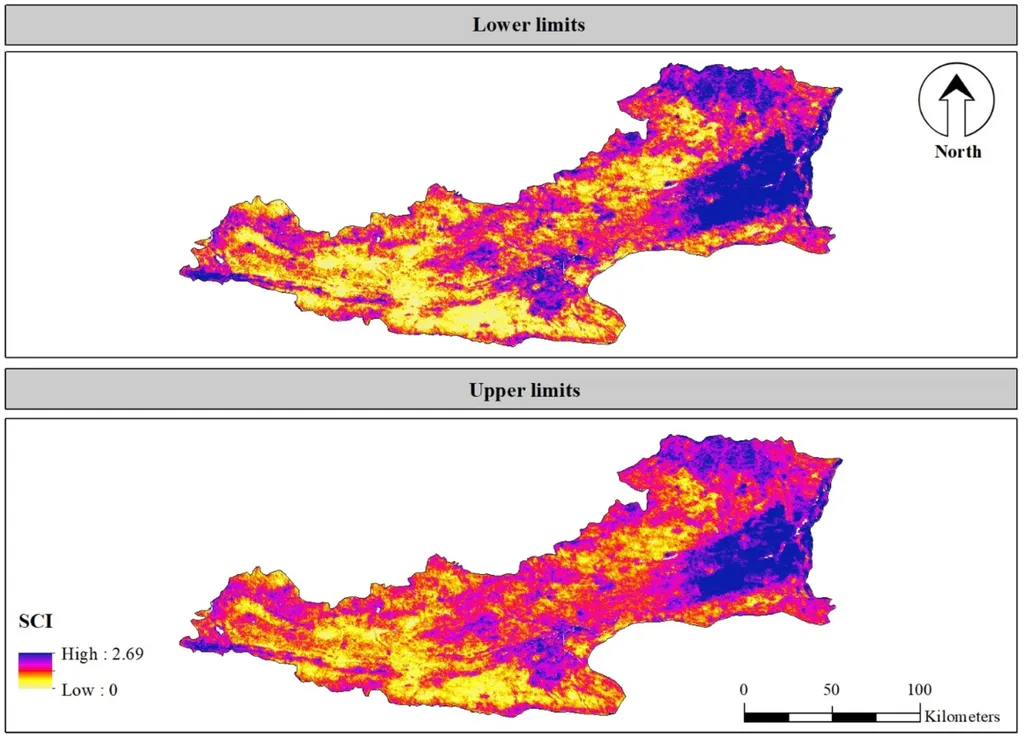
In the heart of Shaanxi Province, China, a groundbreaking study is reshaping how we understand and combat soil crusting, a pervasive issue threatening agricultural productivity. Researchers, led by Fengwei Zhang from the Key Laboratory of Xinjiang Coal Resources Green Mining at the Xinjiang Institute of Engineering, have harnessed the power of machine learning and remote sensing to map soil crusting with unprecedented precision. Their findings, published in *Scientific Reports*, offer a beacon of hope for farmers and agronomists grappling with this silent menace.
Soil crusting, a form of land degradation, compromises soil quality and functionality, ultimately stifling crop growth. Accurate identification of affected areas is crucial for implementing targeted soil management practices. Zhang and his team collected 520 soil samples from the top 10 centimeters of soil across agricultural lands in Shaanxi Province. They calculated the Soil Crusting Index (SCI) for each sample and fed the data into two machine learning algorithms: Random Forest (RF) and Multiple Linear Regression (MLR).
The results were striking. The RF model outperformed MLR, demonstrating a higher coefficient of determination (R² = 0.79 vs. 0.65), lower root mean square error (RMSE = 0.161 vs. 0.242), and reduced bias (0.031 vs. 0.130). “The Random Forest model’s superior performance was evident,” Zhang noted. “It provided a more accurate and reliable prediction of soil crusting, which is vital for effective soil management.”
The study identified the Clay Index (CI) as the most influential predictor of SCI, with precipitation, runoff, and vegetation-related factors also playing substantial roles. These insights could revolutionize soil management practices, enabling farmers to optimize irrigation, planting, and cultivation strategies.
The commercial implications for the agriculture sector are profound. High-resolution mapping of soil crusting allows for targeted interventions, reducing the need for blanket treatments and minimizing input costs. “This research provides a powerful tool for precision agriculture,” Zhang explained. “By identifying high-risk areas, farmers can allocate resources more efficiently, enhancing productivity and sustainability.”
Looking ahead, the study recommends exploring hybrid modeling approaches that combine RF with other algorithms. This could lead to even more accurate predictions and a deeper understanding of soil crust dynamics. “The future of soil management lies in integrating advanced technologies,” Zhang said. “By leveraging machine learning and remote sensing, we can develop more effective strategies to mitigate soil crusting and ensure the long-term health of our agricultural lands.”
As the agriculture sector continues to evolve, this research paves the way for innovative solutions that address one of its most pressing challenges. With the insights gained from this study, farmers and agronomists can take proactive steps to protect their soils, secure their livelihoods, and contribute to a more sustainable future.