
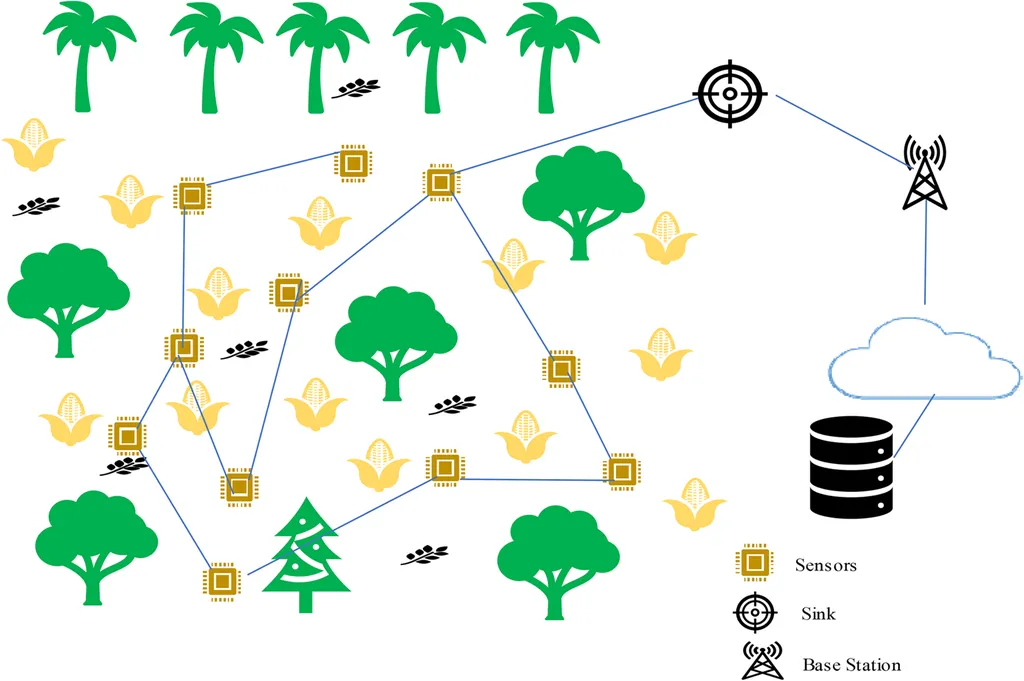
In the ever-evolving landscape of wireless sensor networks, a novel algorithm has emerged that promises to significantly enhance the efficiency and longevity of energy-harvesting systems. This breakthrough, detailed in a recent study published in *Scientific Reports*, introduces the MCSOC (Modified Cat-Swarm-Optimization based clustering) algorithm, a method designed to optimize clustering in energy-harvesting wireless sensor networks (EH-WSNs). The research, led by Sanjai Prasada Rao Banoth from the School of Technology at Woxsen University, offers a fresh perspective on how to extend the lifespan and improve the performance of sensor networks, with profound implications for precision agriculture and other sectors.
At the heart of this innovation lies the MCSOC algorithm, which employs a multi-objective fitness function to select cluster heads. This function co-optimizes residual energy, intra-cluster distance, inter-cluster transmission cost to the sink, and the distance between energy-harvesting nodes and the sink. “The key to our approach is the domain-aware optimization that considers both the energy dynamics and communication costs,” explains Banoth. “This holistic view allows us to achieve a more balanced and efficient network performance.”
The study evaluated MCSOC in two deployment scenarios, each with 200 nodes, and compared it against several benchmark methods, including NEHCP, ROTEE, SMEOR, and GAPSO-H. The results were impressive. MCSOC demonstrated a longer network lifetime, higher throughput, and a significant reduction in early dead nodes. Specifically, it enhanced network performance, stability, and throughput by 42.13%, 45.57%, and 48.48% over GAPSO-H, and by 63.13%, 62.2%, and 58.68% over SMEOR, respectively.
For the agriculture sector, these advancements are particularly noteworthy. Precision agriculture relies heavily on sensor networks to monitor soil conditions, crop health, and environmental factors. The ability to extend the lifespan of these networks while maintaining high performance can lead to more efficient and sustainable farming practices. “Imagine a field of sensors that can operate for years without the need for frequent battery replacements,” says Banoth. “This not only reduces maintenance costs but also ensures continuous and reliable data collection, which is crucial for making informed agricultural decisions.”
The commercial impact of this research extends beyond agriculture. Smart-city environmental monitoring and industrial health deployments can also benefit from the enhanced stability and longevity offered by MCSOC. As the demand for IoT devices continues to grow, the need for efficient and reliable sensor networks becomes increasingly critical. This research paves the way for future developments in the field, offering a robust solution that addresses the challenges of energy management and communication costs in wireless sensor networks.
In the rapidly advancing world of technology, innovations like MCSOC highlight the potential for significant improvements in how we monitor and manage our environment. As researchers continue to refine and expand upon these findings, the future of wireless sensor networks looks brighter and more efficient than ever before.