
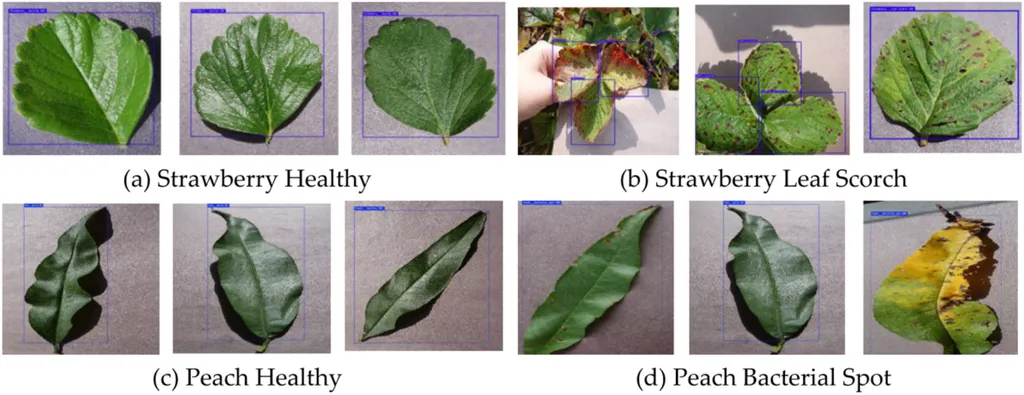
In the ever-evolving landscape of agricultural technology, a groundbreaking review published in *BioData Mining* is set to revolutionize how we approach plant leaf disease (PLD) detection. Led by Chhaya Gupta from the Department of Computer Science and Applications at Maharshi Dayanand University, the research delves into the capabilities of the You Only Look Once (YOLO) family of object detection models, offering a comprehensive analysis of their role in identifying PLDs with unprecedented accuracy and speed.
The agricultural sector has long grappled with the challenges posed by plant leaf diseases, which can lead to significant crop losses and threaten food security. Early detection is crucial, and recent advancements in deep learning (DL) have paved the way for automated, high-accuracy solutions. Among these, the YOLO models have emerged as a frontrunner, capable of real-time disease detection.
Gupta’s review provides an in-depth synthesis of YOLO-based methods, from YOLOv1 to the latest YOLOv10, including domain-specific variants like CTB-YOLO for coriander, BED-YOLO (YOLOv10n), and RAG-augmented YOLOv8 for coffee. “This review presents a structured dataset catalog containing information on size, resolution, disease classes, and limitations, such as imbalance and annotation problems,” Gupta explains. This meticulous cataloging is a significant step forward, offering a clear benchmark for future research and practical applications.
One of the most compelling aspects of this research is its comparative benchmarking analysis. By evaluating performance measures such as accuracy, precision, recall, F1-score, mean Average Precision, and frames per second across different YOLO versions, the study illustrates the trade-offs between speed and accuracy. This information is invaluable for farmers and agritech companies looking to implement the most effective disease detection systems.
The commercial implications of this research are substantial. With the ability to detect diseases in real-time, farmers can take immediate action to mitigate losses, ultimately boosting productivity and profitability. “This review gives forward-looking discussion on open challenges and future research directions, including lightweight YOLO models to run on mobile,” Gupta adds, highlighting the potential for mobile-based solutions that can be easily integrated into existing farming practices.
As we look to the future, the research opens up exciting possibilities for sustainable agriculture. The development of lightweight YOLO models that can run on mobile devices could democratize access to advanced disease detection technology, empowering small-scale farmers and enhancing global food security.
In conclusion, Gupta’s review is a summative reference and a new contribution to the progress of YOLO-based PLD detection. It not only provides a comprehensive overview of current methods but also sets the stage for future innovations in the field. As the agricultural sector continues to embrace technology, this research will undoubtedly play a pivotal role in shaping the future of sustainable farming.