
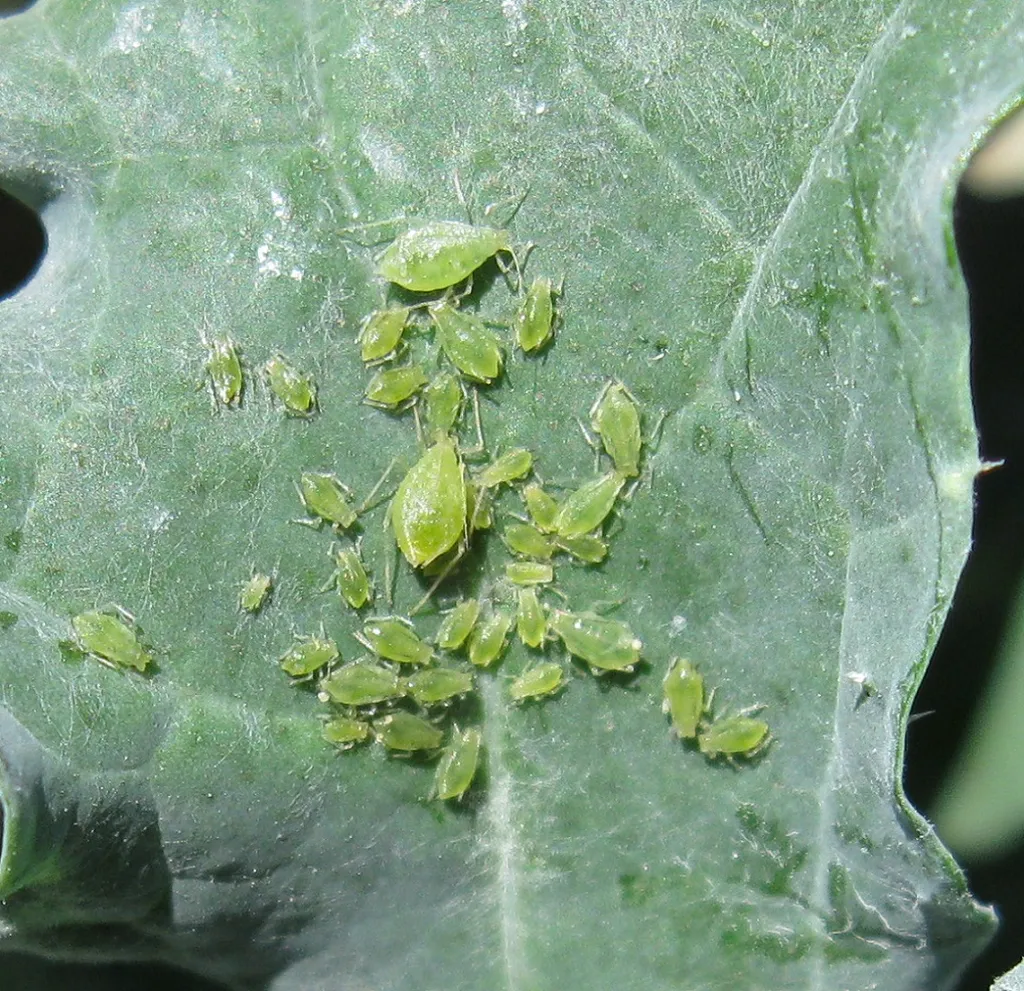
In the quest for sustainable agriculture, researchers have made a significant stride by demonstrating that intercropping broccoli with basil can effectively reduce aphid populations. This finding, published in the *Journal of Sustainable Agriculture and Environment*, offers a promising alternative to chemical pest control, with potential benefits for both farmers and the environment.
Aphids are a major pest in broccoli crops, causing significant damage and reducing yields. Conventional pest control methods often rely on chemical insecticides, which can have harmful environmental impacts and contribute to pesticide resistance. The study, led by Rayana M. R. Carvalho from the Department of Entomology and Acarology at the Luiz de Queiroz College of Agriculture, University of São Paulo, explored a more sustainable approach: intercropping broccoli with basil.
The research combined laboratory experiments with sophisticated mathematical modeling to understand how intercropping affects aphid population dynamics. “We found that aphids significantly avoided broccoli leaves when they were intercropped with basil,” Carvalho explained. “This preference for monoculture broccoli led to a significant reduction in aphid population growth rates in the intercropped system.”
The study employed both non-spatial and spatial models to simulate aphid dispersal and plant-aphid interactions. These models revealed that the presence of basil had a repellent effect on aphids, which, combined with spatial population coupling, led to cyclic oscillations in plant and aphid populations. Over time, these oscillations stabilized to a steady equilibrium, indicating a more balanced and sustainable ecosystem.
The commercial implications of this research are substantial. By reducing the need for chemical insecticides, intercropping broccoli with basil can lower production costs for farmers and minimize environmental impact. “Our results suggest that broccoli-basil intercropping enhances pest regulation, offering a sustainable alternative to chemical pest control,” Carvalho noted. However, the study also highlighted that the efficacy of this approach depends on factors such as aphid dispersal rates and the spatial domain size of the crop.
This research opens up new avenues for sustainable agriculture. As the agricultural sector continues to grapple with the challenges of pest management and environmental sustainability, intercropping practices like those explored in this study could become a cornerstone of modern farming. By integrating such practices, farmers can not only improve crop yields but also contribute to a healthier ecosystem.
The findings of this study underscore the importance of well-designed experiments and robust analytical models in evaluating agroecological system performance and resilience. As we move towards more sustainable agricultural practices, such research will be crucial in shaping the future of farming.