
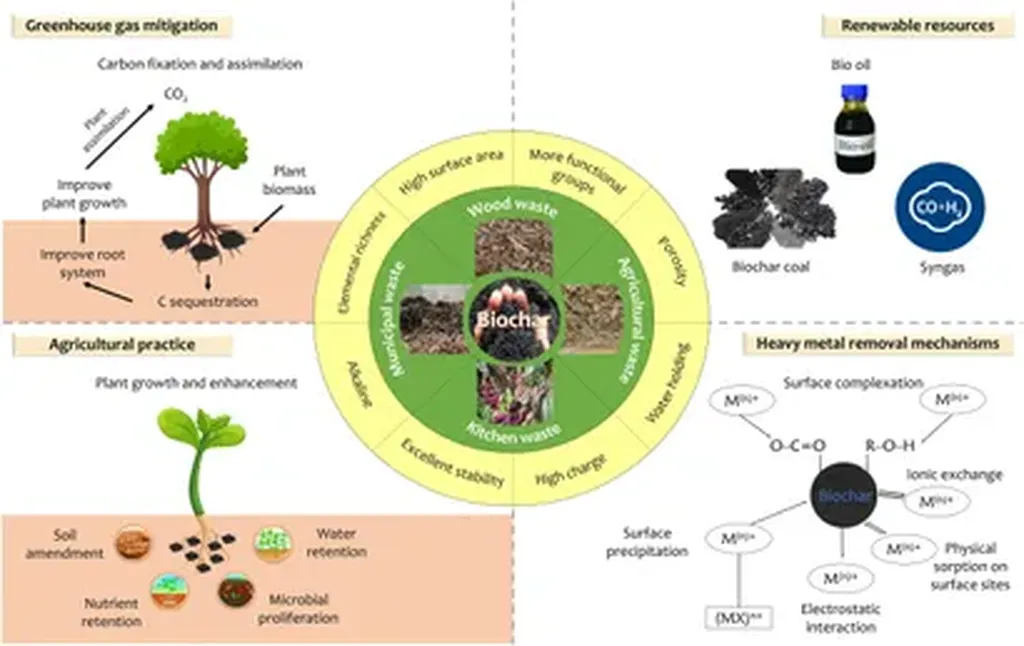
In the quest for sustainable agriculture, a recent study published in the *Journal of Sustainable Agriculture and Environment* has unveiled the multifunctional potential of biochar derived from wood gasification. The research, led by Nicola Colatorti of the Dipartimento di Scienze del Suolo, della Pianta e degli Alimenti at Università degli Studi di Bari Aldo Moro, explores how this biochar can influence both agrochemical dynamics and plant growth, offering promising implications for the agriculture sector.
Biochar, a carbon-rich product obtained from the pyrolysis of organic materials, has long been recognized for its ability to improve soil health. However, this study takes a deeper dive into its role in controlling the retention and leaching of the long-persistent fungicide boscalid (BOS) in soil, as well as its impact on early plant growth.
The researchers characterized the biochar using advanced techniques such as inductively coupled plasma-atomic emission spectroscopy (ICP-AES), scanning electron microscopy (SEM), Fourier transform infrared (FTIR) spectroscopy, and Brunauer-Emmet-Teller (BET) analysis. They then evaluated the adsorption and desorption of BOS on the biochar, modeling the experimental data with various theoretical equations.
The results were striking. Adsorption studies demonstrated a rapid and significant retention of BOS on the biochar, following a pseudo-second order kinetic model that indicated the contribution of chemisorption. The adsorption isotherms of BOS fitted well the Freundlich model, with distribution coefficients (Kd) values of 5.5, 23.5, and 28.3 mg g−1 at interaction temperatures of 10, 20, and 30°C, respectively. Notably, minimal release of BOS was observed after four desorption cycles, suggesting a long-term retention of the compound on the biochar.
Leaching experiments in soil columns further revealed that the addition of 1%, 2%, and 5% biochar was effective in countering the downward movement of BOS, with the activity being directly proportional to the dose. This finding is particularly significant for the agriculture sector, as it points to a potential solution for reducing the environmental impact of persistent agrochemicals.
Moreover, bioassays on cucumber and sunflower plants treated with 0.04% and 0.1% (w/v) biochar did not show inhibitory effects. In fact, there was a stimulation of root elongation in cucumber at the higher dose. “The overall results obtained confirmed the multifunctionality of this material,” stated Colatorti, highlighting its potential role in sustainable agriculture and soil health protection.
The study’s findings suggest that biochar could play a substantial role in controlling the dynamics of organic xenobiotics in soil without exerting inhibitory effects on plants. This multifunctionality could revolutionize agricultural practices, offering a sustainable approach to soil amendment and agrochemical management.
As the agriculture sector continues to grapple with the challenges of sustainability and environmental protection, this research offers a glimmer of hope. By harnessing the multifunctional potential of biochar, farmers and agronomists may soon have a powerful tool at their disposal to enhance soil health, control agrochemical dynamics, and promote early plant growth.
The implications of this research are far-reaching, potentially shaping future developments in the field of sustainable agriculture. As Colatorti and his team continue to explore the multifunctional capabilities of biochar, the agriculture sector can look forward to innovative solutions that balance productivity with environmental stewardship.