
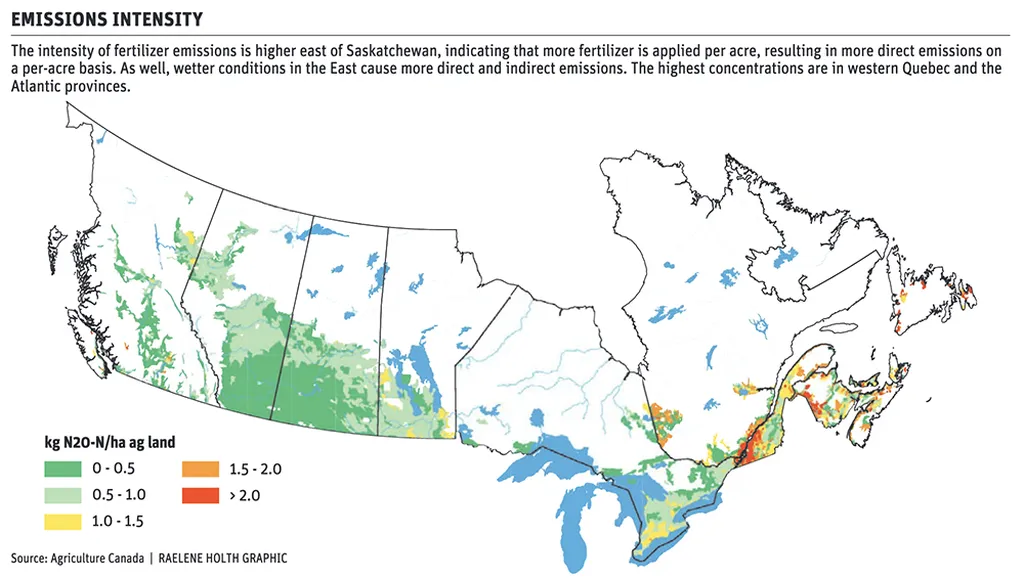
In the heart of Canada’s cold temperate regions, a silent shift is underway, one that could have significant implications for both the environment and the agricultural sector. A recent study published in the *Journal of Sustainable Agriculture and Environment* has shed light on the often-overlooked emissions of nitrous oxide (N2O) from croplands during the nongrowing season, particularly in the late winter and early spring. The research, led by Kosoluchukwu Ekwunife of McGill University in Sainte-Anne-de-Bellevue, Quebec, uses the Denitrification and Decomposition (DNDC) model to simulate historical and future N2O emissions under intensive grain corn production in Southern Quebec.
The findings are striking. During the historical period from 1990 to 2019, the study revealed that mean winter N2O emissions were greatest in warm-wet years. As the snow-water equivalent (SWE) declined, emissions increased, suggesting a complex interplay between climate variables and N2O fluxes. Looking ahead, the model predicts a 10% increase in winter/spring N2O emissions by the period 2038–2067. This rise is driven by a 1°C increase in winter soil temperature and an 8% increase in water-filled pore space (WFPS), with SWE expected to decrease by 1 mm annually.
For the agricultural sector, these predictions could have substantial commercial impacts. Nitrous oxide is a potent greenhouse gas, with a global warming potential 298 times that of carbon dioxide. Increased emissions could not only contribute to climate change but also potentially lead to regulatory pressures on farmers. “Understanding these emissions is the first step in developing effective mitigation strategies,” Ekwunife noted. “This research highlights the urgency of addressing N2O emissions from agricultural soils, particularly in regions experiencing significant climate shifts.”
The study also underscores the importance of modeling in predicting future emissions. The DNDC model, which simulates the biogeochemical processes involved in N2O production and consumption, provides a powerful tool for understanding the complex dynamics of cold-region agroecosystems. As climate change continues to alter temperature and precipitation patterns, such models will become increasingly valuable for predicting and managing emissions.
The research also points to the need for further investigation into the underlying climatic triggers of N2O emissions. The study’s findings suggest that freeze-thaw cycles and snowpack dynamics play crucial roles in regulating emissions, but more research is needed to fully understand these processes. “This is just the beginning,” Ekwunife said. “There’s still much we don’t know about how these emissions respond to climate variability, and further research is needed to fill these gaps.”
As the agricultural sector grapples with the challenges posed by climate change, this research offers a timely reminder of the importance of understanding and managing N2O emissions. By developing effective mitigation strategies, farmers can not only reduce their environmental impact but also ensure the long-term sustainability of their operations. The study, published in the *Journal of Sustainable Agriculture and Environment*, provides a crucial step forward in this endeavor, offering valuable insights into the complex dynamics of N2O emissions in cold-region agroecosystems.