
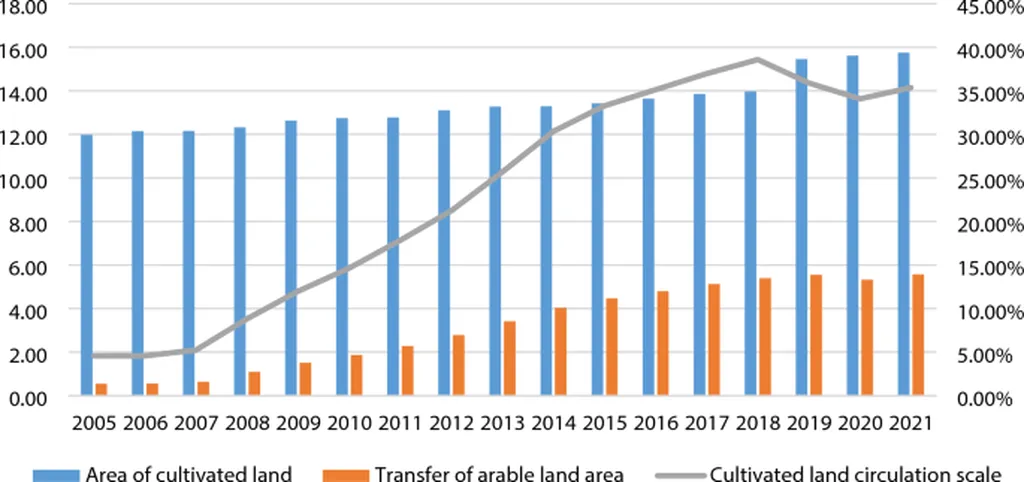
In the heart of China’s agricultural landscape, a significant shift is underway, one that could redefine the future of farming and food security. A recent study published in *Frontiers in Sustainable Food Systems* has shed light on the intricate relationship between cultivated land use transformation (CLUT) and agricultural green total factor productivity (AGTFP) in the Yellow River Basin. The research, led by Bolun Zhang from the Chinese Research Academy of Environmental Sciences in Beijing, offers a compelling narrative that could steer policy and practice in sustainable agriculture.
The Yellow River Basin, a critical region for China’s food security, has witnessed a dynamic transformation in its cultivated land use over the past two decades. The study, which analyzed panel data from 62 cities between 2000 and 2020, revealed a fluctuating upward trend in the CLUT index. This trend, characterized by a peak in the southeastern regions and a low in the central areas, suggests a movement toward regional equalization. “The transformation of cultivated land use is not just a geographical shift; it’s a strategic move towards sustainable agricultural development,” Zhang remarked.
The study employed advanced methodologies, including the entropy weight method and the super-efficient non-radial SBM model with the GML index, to measure AGTFP. The findings indicated a significant positive impact of CLUT on AGTFP, with a stronger effect observed in major grain-producing areas and eastern regions. “Cultivated land use transformation is a double-edged sword,” Zhang explained. “It not only enhances productivity but also promotes environmental sustainability, a critical factor for the future of agriculture.”
The commercial implications of these findings are profound. For the agriculture sector, understanding and leveraging CLUT can lead to substantial gains in productivity and efficiency. The study found that both functional and modal transitions of cultivated land use significantly promote AGTFP, with modal transitions being more effective. This insight could guide farmers and agribusinesses in optimizing their land use strategies to maximize productivity and profitability.
Moreover, the study’s findings offer a scientific reference for policymakers aiming to ensure food security and promote high-quality development in the agricultural economy. The spatio-temporal perspective provided by the research can inform regional policies, ensuring that agricultural practices are tailored to local conditions and needs.
The research also highlights the importance of sustainable development goals in shaping agricultural practices. By promoting green total factor productivity, the agriculture sector can contribute to environmental sustainability while ensuring food security. This dual focus is crucial for the long-term viability of the sector and the well-being of future generations.
As the world grapples with the challenges of climate change and food security, the insights from this study offer a beacon of hope. By understanding and harnessing the power of cultivated land use transformation, the agriculture sector can pave the way for a sustainable and prosperous future. The research led by Bolun Zhang, published in *Frontiers in Sustainable Food Systems*, serves as a testament to the transformative potential of innovative agricultural practices and policies.