
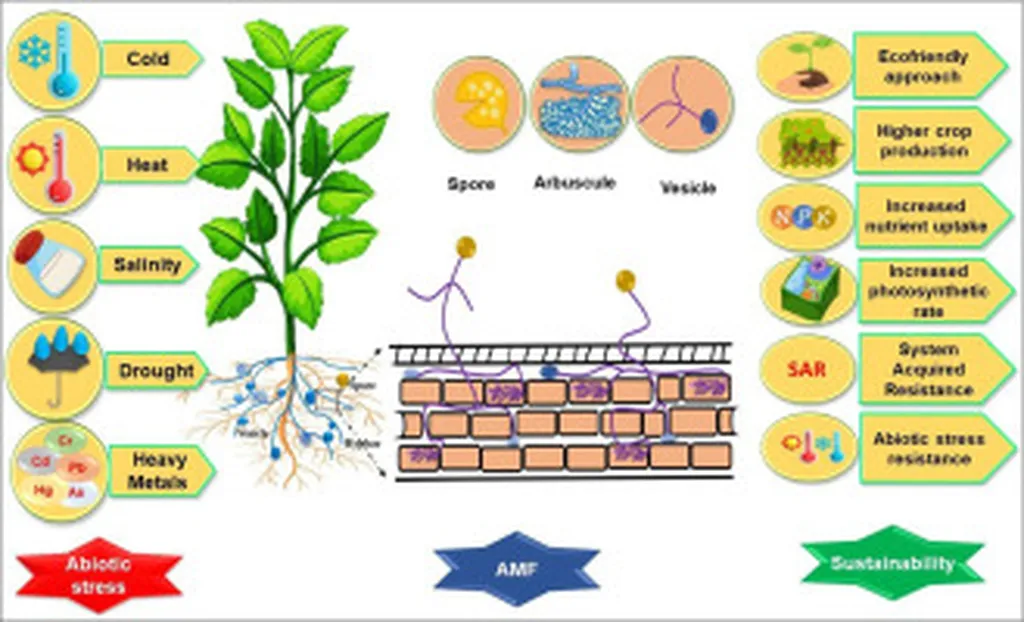
In the quest to bolster crop resilience and productivity, a recent study published in the *Journal of Sustainable Agriculture and Environment* has shed light on the intricate dance between arbuscular mycorrhizal fungi (AMF) and common beans under drought stress. The research, led by Sahar Panahi-Moghaddam of the Faculty of Agriculture at Shahrood University of Technology in Iran, explores how these symbiotic fungi and the phytohormone abscisic acid (ABA) influence potassium uptake and the expression of K⁺ transporter genes in Phaseolus vulgaris.
The study reveals that AMF symbiosis significantly enhances potassium and phosphorus concentrations in both root and shoot tissues of common beans. Under normal water conditions, symbiotic interaction with *Funneliformis mosseae* and *Rhizophagus irregularis* increased shoot potassium content by 1.55-fold and 1.64-fold, respectively. Even under drought stress, these fungi proved their mettle by boosting nutrient uptake compared to non-symbiotic plants.
“Our findings suggest that AMF symbiosis can be a game-changer for agriculture, especially in regions prone to drought,” Panahi-Moghaddam remarked. “By enhancing nutrient uptake and improving photosynthetic pigment content, these fungi can help crops thrive under challenging conditions.”
The study also delved into the expression patterns of PvKUPs, revealing that most of these genes are induced in response to symbiosis with AMFs and drought stress. Notably, PvKUP3 and PvKUP5 genes were more induced under symbiosis with *R. irregularis*, while PvKUP11 and PvKUP18 showed a preference for *F. mosseae*.
The commercial implications of this research are substantial. As climate change continues to disrupt traditional farming practices, the need for resilient crops has never been greater. By leveraging the symbiotic relationship between AMF and crops, farmers can enhance nutrient uptake, improve photosynthetic efficiency, and ultimately increase yields.
“Understanding the mechanistic details of how AMF and ABA jointly regulate potassium uptake can open new avenues for developing drought-resistant crop varieties,” Panahi-Moghaddam added. “This knowledge can be instrumental in designing targeted agricultural practices and breeding programs.”
The study’s insights into the simultaneous interaction of symbiosis with AMFs, drought stress, and ABA application on potassium uptake and transport provide a valuable foundation for future research. As we continue to unravel the complexities of plant-microbe interactions, the potential for innovative agricultural solutions grows ever more promising.
In an era where sustainability and productivity are paramount, this research offers a beacon of hope for the future of agriculture. By harnessing the power of symbiotic fungi, we can cultivate a more resilient and bountiful future for our crops and, by extension, our planet.